Reaktionsgleichung

[Na+].[N+:2]([C:5]1[CH:11]=[CH:10][C:8]([O-:9])=[CH:7][CH:6]=1)([O-:4])=[O:3].Cl.Cl[CH2:14][CH2:15][N:16]1[CH2:20][CH2:19][CH2:18][CH2:17]1.C(=O)([O-])[O-].[K+].[K+]>O.C(OCC)(=O)C>[N+:2]([C:5]1[CH:11]=[CH:10][C:8]([O:9][CH2:14][CH2:15][N:16]2[CH2:20][CH2:19][CH2:18][CH2:17]2)=[CH:7][CH:6]=1)([O-:4])=[O:3]Komponenten
Edukt 3


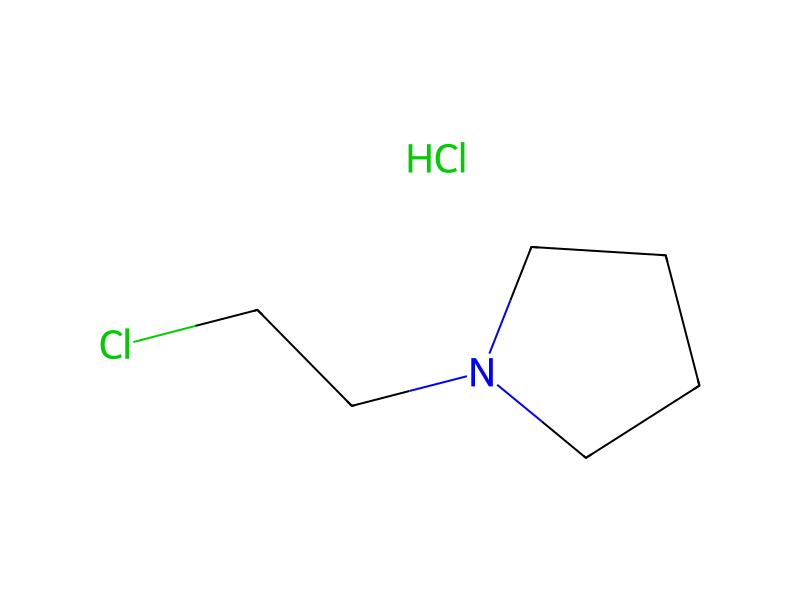
Produkt 1

Reagenzien, Katalysatoren, Lösungsmittel 2


Reaktionsbedingungen
- Temperatur
- 130 °C
Versuchsvorschrift
Two identical reactions were set up side-by-side as follows. To a mixture of p-nitrophenoxide sodium salt (20.0 g, 124 mmol) and N-(2-chloroethyl)pyrrolidine hydrochloride (21.0 g, 123.5 mmol) was added 300 mL of xylenes followed by potassium carbonate (23.5 g, 170 mmol). The heterogenous mixture was heated under nitrogen at 130° C. overnight. The reaction was diluted with water and 200 mL of ethyl acetate. The layers were separated and the organic layer was washed with saturated aqueous sodium chloride. The aqueous layers were back-extracted with one portion of methylene chloride and the combined organic layers were dried over sodium sulfate, filtered, and concentrated. Silica gel flash chromatography of the combined residues from both reactions (10% methanol/ethyl acetate to 20% methanol/ethyl acetate to 50% methanol/ethyl acetate) afforded 35.22 g (60%) of the title compound of Step A. MS 237.4 (M+1)+
Aufarbeitung
- customThe layers were separated
- washthe organic layer was washed with saturated aqueous sodium chloride
- extractionThe aqueous layers were back-extracted with one portion of methylene chloride
- dry with materialthe combined organic layers were dried over sodium sulfate
- filtrationfiltered
- concentrationconcentrated
Quellen und Nachweise
- ORD-Eintrag
- ord-cc0a8c6f0b834baba77783d60930df7d
- Quelldatensatz
- uspto-grants-2006_05
- Patentnummer
- US07053212B2
Verknüpfte Notizen
Wird geladen…