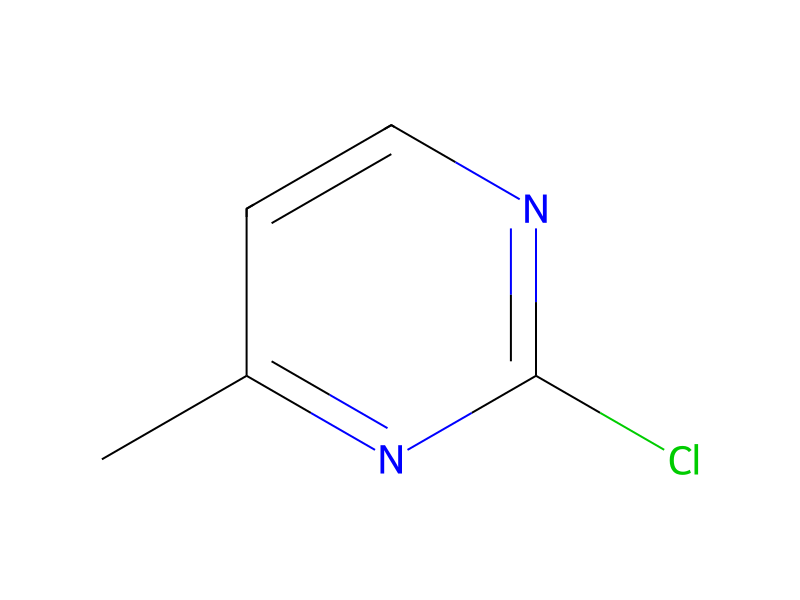
Br[C:2]1[C:7]([CH3:8])=[CH:6][C:5]([CH3:9])=[CH:4][C:3]=1[CH3:10].C([Li])(C)(C)C.[Cl:16][C:17]1[N:22]=[C:21]([CH3:23])[CH:20]=[CH:19][N:18]=1>CCOCC>[Cl:16][C:17]1[N:18]=[C:19]([C:2]2[C:7]([CH3:8])=[CH:6][C:5]([CH3:9])=[CH:4][C:3]=2[CH3:10])[CH:20]=[C:21]([CH3:23])[N:22]=1Part A: 2-Bromomesitylene (1.49 g), dry ether (45 mL), and t-butyllithium (1.5 M, 9 mL) were stirred at -78° C. for 10 minutes and 2-chloro-4-methylpyrimidine (643 mg) dissolved in dry ether (10 mL) was added. The reaction was stirred at -30° C. for 1.5 hours and quenched with a mixture of acetic acid (386 μL), water (23 μL), and tetrahydrofuran (5 mL). 2,3-Dichloro-5,6-dicyano-1,4-benzoquinone (1.25 g) dissolved in tetrahydrofuran (10 mL) was added to the reaction which was then stirred 15 minutes and washed with 1 N sodium hydroxide (three 50 mL portions), dried, and concentrated. The crude product was chromatographed on silica gel using ethyl acetate/hexane (1:9) as eluent affording 2-chloro-6-methyl-4-(2,4,6-trimethylphenyl)pyrimidine (0.99 g) as a white solid.