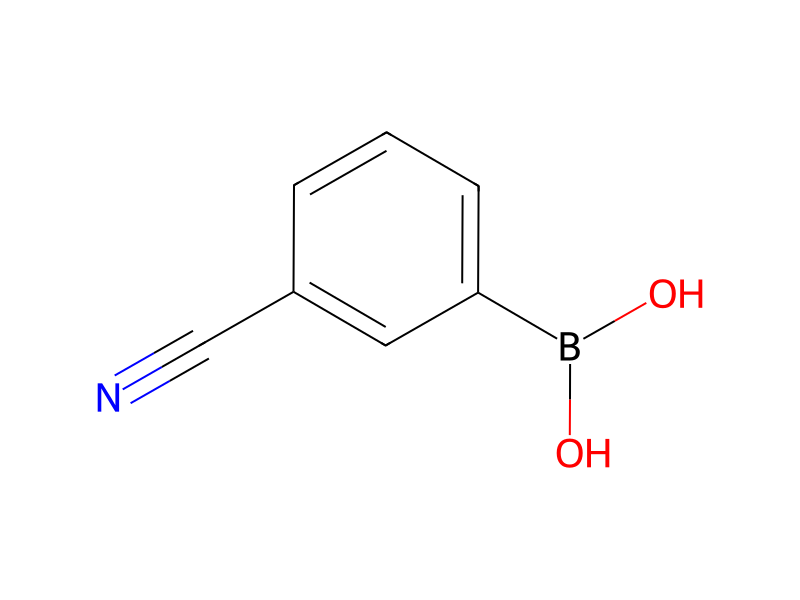
[C:1]([C:3]1[CH:4]=[C:5](B(O)O)[CH:6]=[CH:7][CH:8]=1)#[N:2].Br[C:13]1[C:14]([CH3:21])=[N:15][C:16]([O:19][CH3:20])=[CH:17][CH:18]=1.C1(C)C=CC=CC=1.C(=O)([O-])[O-].[Na+].[Na+]>C1(P(C2C=CC=CC=2)C2C=CC=CC=2)C=CC=CC=1.C1(P(C2C=CC=CC=2)C2C=CC=CC=2)C=CC=CC=1.C1(P(C2C=CC=CC=2)C2C=CC=CC=2)C=CC=CC=1.C1(P(C2C=CC=CC=2)C2C=CC=CC=2)C=CC=CC=1.[Pd].CO>[CH3:20][O:19][C:16]1[N:15]=[C:14]([CH3:21])[C:13]([C:5]2[CH:4]=[C:3]([CH:8]=[CH:7][CH:6]=2)[C:1]#[N:2])=[CH:18][CH:17]=1To a nitrogen flushed mixture of 3-cyanophenylboronic acid (5.0 g, 34 mmol), 3-bromo-6-methoxy-2-methylpyridine (4.6 g, 22.7 mmol) and palladium tetrakis(triphenylphosphine) (789 mg, 0.68 mmol) is added toluene (150 mL), methanol (12 mL) and sodium carbonate (22.7 mmol) and the mixture is heated overnight at reflux. The cooled reaction is concentrated and the residue is purified by chromatography eluting with cyclohexane-3.2 to 9% ethyl acetate. Product containing fractions are combined and concentrated to afford 3-(6-methoxy-2-methylpyridin-3-yl)benzonitrile (3.09 g, 61% yield) as a white solid. LC/MS: MS m/e=225 (M+H); RT 3.58 min; 1H NMR (CDCl3, δ ppm) 7.65 (1H, m), 7.60 (1H, m), 7.56 (2H, m), 7.40 (1H, d), 6.63 (1H, d), 3.98 (3H, s), 2.40 (3H, s).