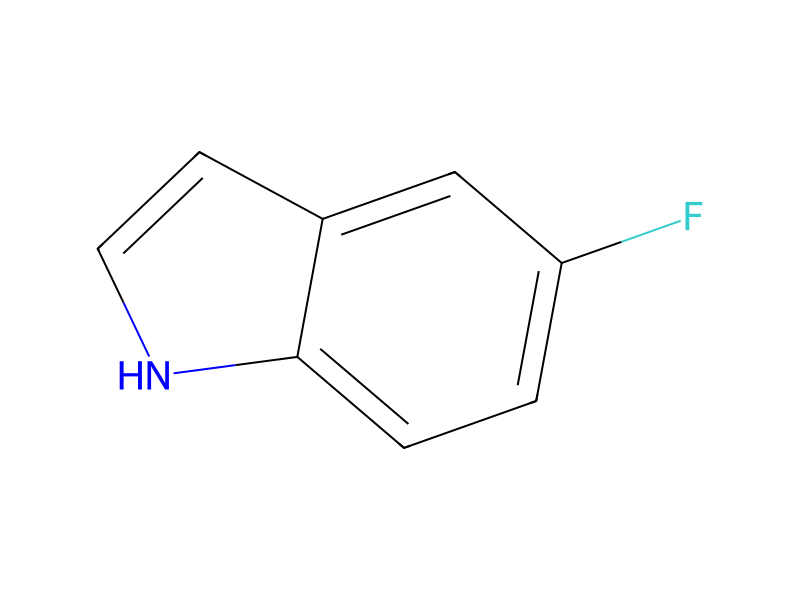
To a solution of 5-fluoroindole x157 (405 mg, 3 mmol, 1 eq) of in DMF (7 ml) maintained under argon is added NaH (60% in mineral oil; 120 mg, 3 mmol, 1 eq). The resulting mixture is stirred for three hours at room temperature, then a solution of 1-(chloromethyl)-4-propylpyrrolidin-2-one x63 in DMF (1 M, 3 ml, 3 mmol, 1 eq) is added. The reaction mixture is stirred for 20 hours at room temperature. Water (70 ml) is added and the resulting mixture is extracted with ethyl acetate (30 ml). The organic phase is washed twice with water and dried over Na2SO4. After filtration and evaporation of volatiles, the crude product is purified by two consecutive chromatographies on silicagel (CH2Cl2/MeOH gradient, then CH2Cl2). Pure 1-[(7-oxido-1H-pyrrolo[2,3-b]pyridin-3-yl)methyl]-4-propylpyrrolidin-2-one 278 is obtained as syrup (274 mg).