Water → 1-Hydroxybenzotriazole hydrate
Reaktionsgleichung

C(C1C=[N:6][N:7]2[C:12](C3C=CC(Cl)=CC=3)=[C:11]([C:20]3C=CC=C[C:21]=3Cl)C=NC=12)(O)=[O:2].[OH2:27].C([N:30]([CH2:33][CH3:34])CC)C>C(Cl)(Cl)Cl>[OH2:2].[OH:27][N:30]1[C:33]2[CH:34]=[CH:21][CH:20]=[CH:11][C:12]=2[N:7]=[N:6]1Komponenten
5
Edukt 3



Produkt 1
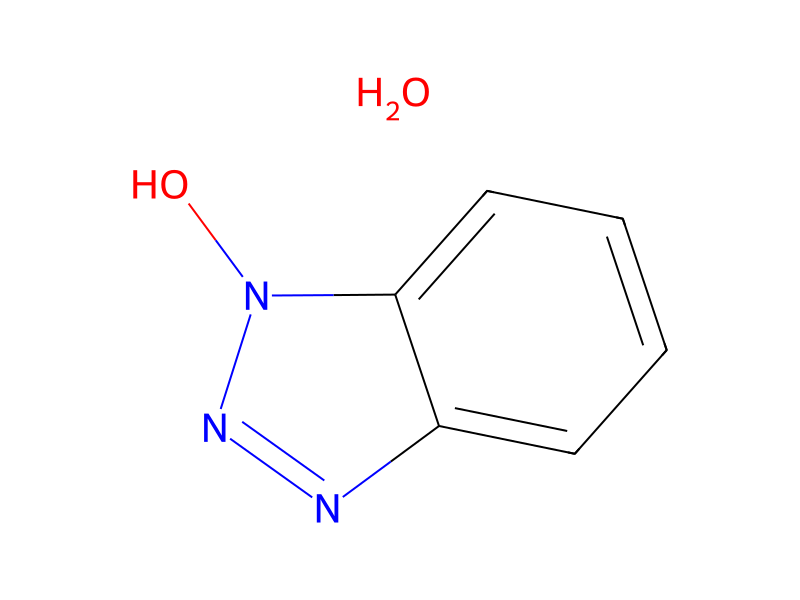
Reagenzien, Katalysatoren, Lösungsmittel 1

Versuchsvorschrift
To a solution of 3-carboxy-6-(2-chlorophenyl)-7-(4-chlorophenyl)-pyrazolo[1,5-a]pyrimidine (compound obtained in Reference Example 1(4), 165 mg) in chloroform (1.0 mL containing amylene) was added the compound obtained in Reference Example 13(2), water-soluble carbodiimide HCl (123 mg), 1-hydroxybenzotriazole monohydrate (97 mg), and triethylamine (178 μL) and the mixture was stirred at room temperature overnight. To the reaction mixture was added an aqueous saturated sodium hydrogencarbonate solution (2 mL) and the mixture was stirred and extracted with chloroform. The extract was concentrated in vacuo and the resultant crude product was purified by a column chromatography on silica gel (solvent; hexane/ethyl acetate=90/10 to 70/30) to give 6-(2-chlorophenyl)-7-(4-chlorophenyl)-3-[N-(4-tetrahydrothiopyranyl)carbamoyl]pyrazolo[1,5-a]pyrimidine (50 mg; yield: 24%) as a pale yellow powder.