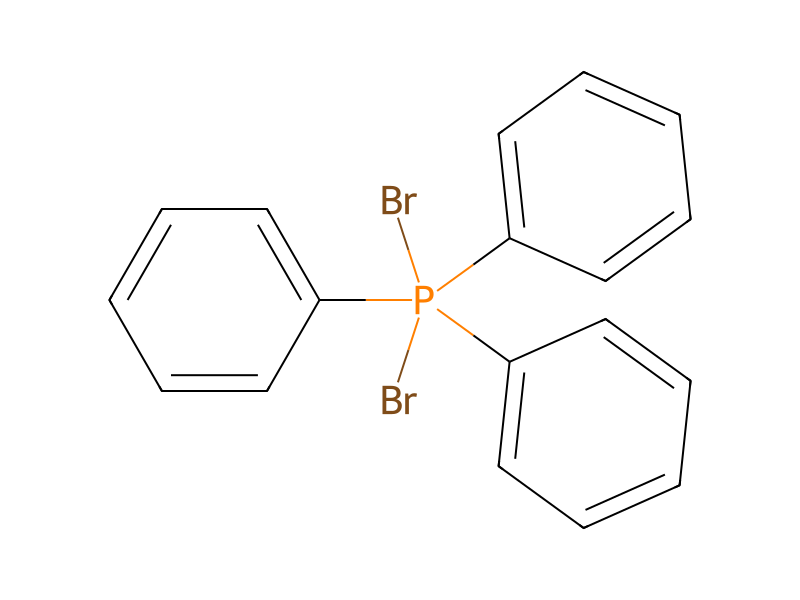
[NH2:1][C:2]1[C:3]([C:9]([NH:11][NH2:12])=[O:10])=[N:4][C:5]([Br:8])=[CH:6][N:7]=1.[Br:13][CH2:14][C:15]1[CH:23]=[CH:22][C:18]([C:19](O)=O)=[CH:17][CH:16]=1.BrP(Br)(C1C=CC=CC=1)(C1C=CC=CC=1)C1C=CC=CC=1.CCN(C(C)C)C(C)C>CC#N>[Br:8][C:5]1[N:4]=[C:3]([C:9]2[O:10][C:19]([C:18]3[CH:22]=[CH:23][C:15]([CH2:14][Br:13])=[CH:16][CH:17]=3)=[N:12][N:11]=2)[C:2]([NH2:1])=[N:7][CH:6]=1To a suspension of 3-amino-6-bromo-pyrazine-2-carbohydrazide (200 mg, 0.86 mmol) and 4-(bromomethyl)benzoic acid (185 mg, 0.86 mmol) in MeCN (4 mL) at room temperature was added dibromo(triphenyl)phosphorane (1.7 g, 4.14 mmol) and the resulting reaction mixture was stirred for 1 h. The reaction mixture was diluted with acetonitrile (2 mL) and DIPEA (668 mg, 900 μL, 5.2 mmol) was added dropwise and the suspension was allowed to stir overnight. The suspension was filtered, washed with CH3CN and hexane, and air dried to provide 5-bromo-3-(5-(4-(bromomethyl)phenyl)-1,3,4-oxadiazol-2-yl)pyrazin-2-amine (240 mg, 68%) as a yellow solid. 1H NMR (400 MHz, DMSO-d6) δ 8.45 (s, 1H), 8.11 (d, J=8.1 Hz, 2H), 7.72 (d, J=8.2 Hz, 2H), 4.82 (s, 2H). LC/MS m/z 412.1 [M+H]+.