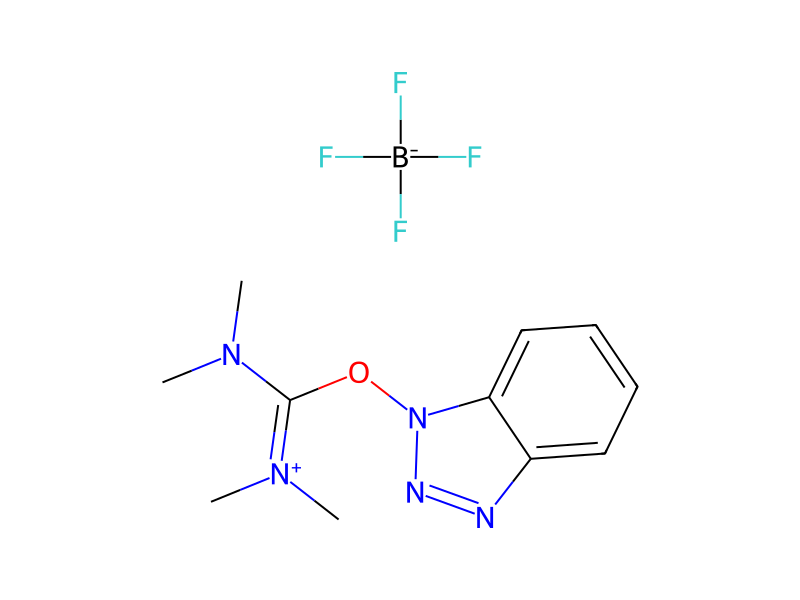
170 μl (0.098 mmol, 0.1 eq.) of N,N-diisopropylethylamine and 204 mg (0.63 mmol, 2 eq.) of TBTU are added to a solution of 100 mg of (2,4-dioxo-1-p-tolyl-1,3-diazaspiro[4.5]dec-3-yl)acetic acid in 30 ml of NMP. The solution is stirred for 20 minutes, and 70 mg (0.47 mmol, 1.5 eq.) of 1-phenylbutylamine (starting material 3) are added. The reaction medium is stirred overnight at room temperature. It is then poured into 1N hydrochloric acid solution and extracted with ethyl acetate. The organic phase is then washed with water, then with 1N sodium hydroxide solution, and then again with water. It is dried over sodium sulfate. The residue is precipitated from dichloromethane and heptane. 2-(2,4-Dioxo-1-p-tolyl-1,3-diazaspiro[4.5]dec-3-yl)-N-(1-phenylbutyl)acetamide is obtained in the form of a white solid.