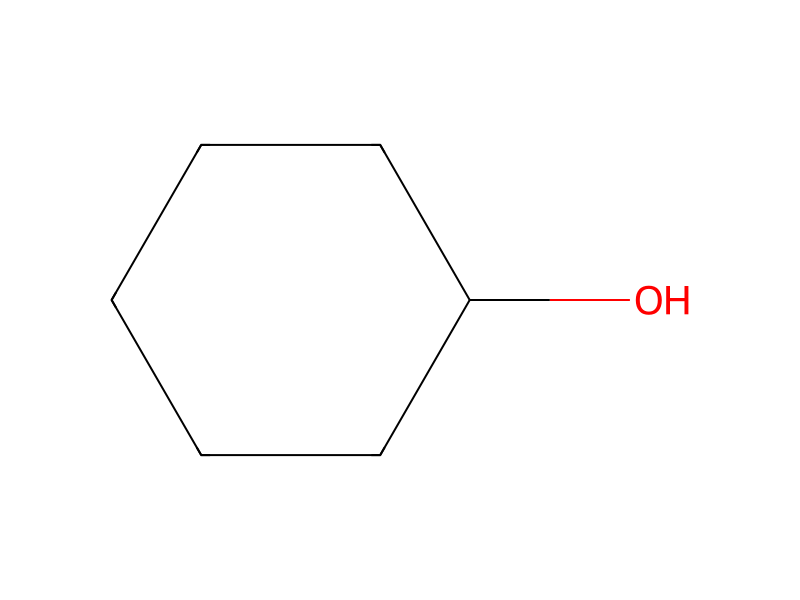
[CH:1]1([OH:7])[CH2:6][CH2:5][CH2:4][CH2:3][CH2:2]1.[K].Cl[C:10]1[C:18]2[NH:17][C:16]([C:19]([F:22])([F:21])[F:20])=[N:15][C:14]=2[C:13]([N+:23]([O-:25])=[O:24])=[CH:12][C:11]=1[N+:26]([O-:28])=[O:27].O>CN(C)P(=O)(N(C)C)N(C)C>[CH:1]1([O:7][C:10]2[C:18]3[NH:17][C:16]([C:19]([F:21])([F:22])[F:20])=[N:15][C:14]=3[C:13]([N+:23]([O-:25])=[O:24])=[CH:12][C:11]=2[N+:26]([O-:28])=[O:27])[CH2:6][CH2:5][CH2:4][CH2:3][CH2:2]1Cyclohexanol (5.4 grams) and potassium (1.9 grams) were reacted in 50 milliliters of dry hexamethylphosphoric triamide. When reaction had ceased, the solution was stirred and 5 grams of 4-chloro-5,7-dinitro-2-trifluoromethylbenzimidazole were added. Stirring was continued overnight. The reaction mixture was then poured into water, acidified, and extracted with ethyl acetate. The ethyl acetate was then removed by evaporation, and the residue was chromatographed on 300 milliliters of silica gel using benzene as eluant. The benzene was removed by evaporation and the crude product was recrystallized from an aliphatic hydrocarbon fraction boiling at 60°-80° C., to which there had been added a trace of benzene. The resulting 4-cyclohexyloxy-5,7-dinitro-2-trifluoromethylbenzimidazole product melted at 151°-2° C. Its identity was confirmed by NMR and by elemental analysis.
Wird geladen…