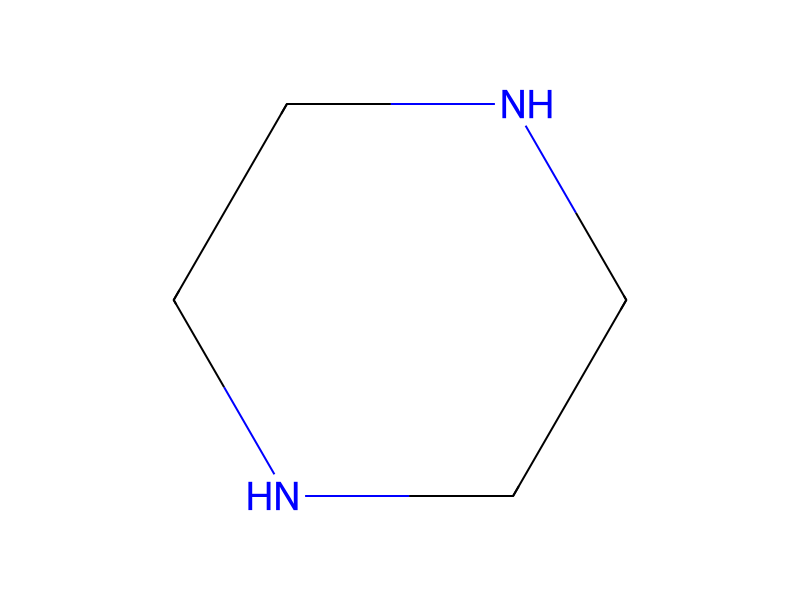
Piperazine → 1-(2,6-Difluorobenzoyl)piperazine
HRID 1993649
Reaktionsgleichung

[NH:1]1[CH2:6][CH2:5][NH:4][CH2:3][CH2:2]1.[F:7][C:8]1[CH:16]=[CH:15][CH:14]=[C:13]([F:17])[C:9]=1[C:10](Cl)=[O:11]>C(O)(=O)C>[F:7][C:8]1[CH:16]=[CH:15][CH:14]=[C:13]([F:17])[C:9]=1[C:10]([N:1]1[CH2:6][CH2:5][NH:4][CH2:3][CH2:2]1)=[O:11]Komponenten
4
Edukt 2

Produkt 1

Reagenzien, Katalysatoren, Lösungsmittel 1

Reaktionsbedingungen
- Temperatur
- 40 °C
Versuchsvorschrift
Charge acetic acid (5 L) to a 22 L flask. Place the reaction in an ice-water bath. Add piperazine (355.00 g, 2.0 equiv; 4.06 moles) in portions with stirring, and increase temperature to ˜40° C. Add another 5 L of acetic acid. Stir until mixture becomes a solution. Adjust cooling bath to ˜13° C. Add 2,6-difluorobenzoyl chloride (355.00 g, 1.00 equiv; 2.01 moles; 253.39 mL) drop wise over a 2 hours period, while maintaining reaction temperature at approximately 13-15° C. Stir overnight. Concentrate under reduced pressure and dissolve residue in 2 L of ice water. Cool flask in an ice water bath. Add 5 N NaOH to adjust pH to 7.5 while maintaining the reaction temperature below 30° C. Filter at ˜10° C. Extract product from filtrate with dichloromethane (4×2 L). Remove solvent under reduced pressure. Dissolve the solid in 1.5 L of methanol at room temperature and filter. Concentrate the methanol solution, then solvent exchange with toluene 2.0 L, afforded pure product. Filter to obtain (2,6-difluorophenyl)-piperazin-1-yl-methanone. Concentrate filtrate and filter again to obtain additional product (total 400 g).