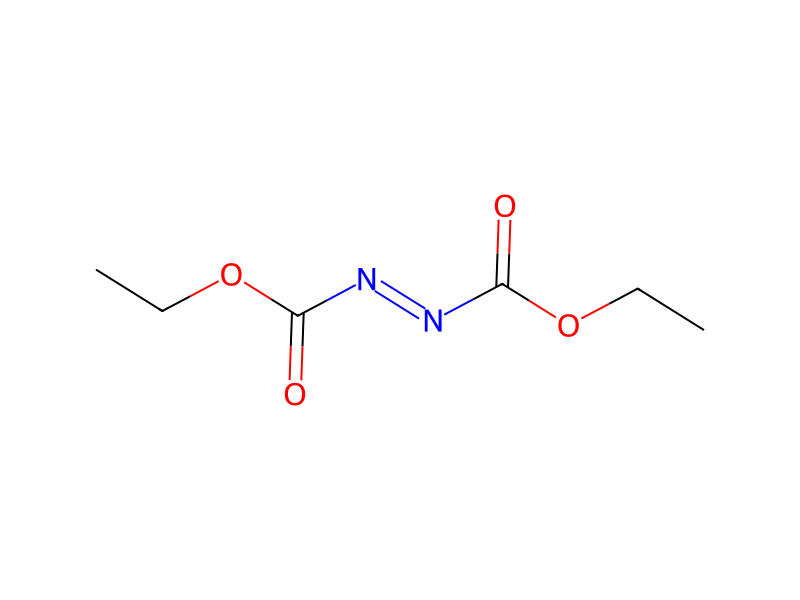
[C:1]([O:5][C:6](=[O:14])[NH:7][C@H:8]1[CH2:12][CH2:11][C@@H:10](O)[CH2:9]1)([CH3:4])([CH3:3])[CH3:2].C1(P(C2C=CC=CC=2)C2C=CC=CC=2)C=CC=CC=1.CCOC(/N=N/C(OCC)=O)=O.C1C=CC(P([N:60]=[N+:61]=[N-:62])(C2C=CC=CC=2)=O)=CC=1>C1COCC1>[C:1]([O:5][C:6](=[O:14])[NH:7][C@H:8]1[CH2:12][CH2:11][C@H:10]([N:60]=[N+:61]=[N-:62])[CH2:9]1)([CH3:4])([CH3:3])[CH3:2]To a stirring solution of cis-(3-hydroxy-cyclopentyl)-carbamic acid tert-butyl ester (850 mg, 4.22 mmol) and triphenylphosphine (1.53 g, 5.83 mmol) in THF (25 mL) cooled to 2° C. was added DEAD reagent (0.92 mL, 5.84 mol) over 5 minutes. The mixture was stirred for 5 minutes and DPPA (1.26 mL, 5.84 mmol) was added over 5 minutes. Stirring was continued for 17 hours at room temperature. The mixture was evaporated to dryness. The residue was stirred in ethyl ether briefly and the white solid triphenylphosphine oxide was removed by filtration (1 g). The filtrate was again reduced in volume and purified by silica gel chromatography eluting with ethyl acetate and hexanes to afford trans-(3-azido-cyclopentyl)-carbamic acid tert-butyl ester (950 mg).