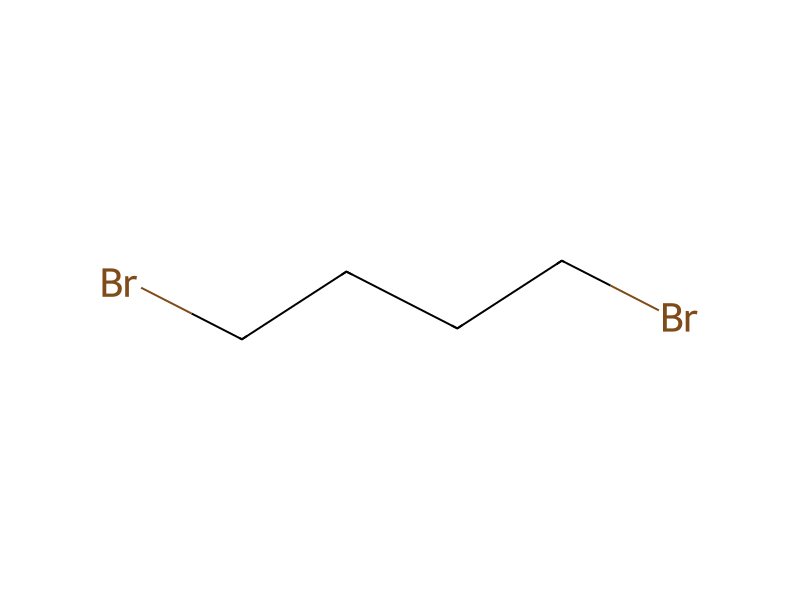
1,4-Dibromobutane → HCID 59474963, Verbindung
HRID 2036552
Reaktionsgleichung

[OH:1][C:2]1[CH:10]=[CH:9][C:5]([C:6]([NH2:8])=[O:7])=[C:4]([N+:11]([O-:13])=[O:12])[CH:3]=1.C(=O)([O-])[O-].[K+].[K+].[Br:20][CH2:21][CH2:22][CH2:23][CH2:24]Br>CC(C)=O>[Br:20][CH2:21][CH2:22][CH2:23][CH2:24][O:1][C:2]1[CH:10]=[CH:9][C:5]([C:6]([NH2:8])=[O:7])=[C:4]([N+:11]([O-:13])=[O:12])[CH:3]=1Komponenten
5
Edukt 3


Produkt 1

Reagenzien, Katalysatoren, Lösungsmittel 1

Versuchsvorschrift
To a solution of 4-hydroxy-2-nitrobenzamide 3 (0.7 g, 0.0038 mol) in 20 mL acetone was added potassium carbonate (2.0 g, 0.015 mol). The reaction mixture was stirred at room temperature for 10 min. Then 1,4-dibromobutane 4 (1.8 mL, 0.015 mol) was added. The resulting mixture was refluxed for 12 h. The progress of the reaction was monitored by thin layer chromatography (TLC). Potassium carbonate was filtered and washed with acetone. The combined filtrate and washings were evaporated. The residue was triturated with methyl tert-butyl ether; the solid separated was filtered and dried to give 4-(4-bromobutoxy)-2-nitrobenzamide 5. White solid (0.85 g, 70%). 1H NMR (400 MHz, CDCl3): δ 1.98-2.03 (m, 2H); 2.04-2.09 (m, 2H); 3.49 (t, J=6.0 Hz, 2H); 4.08 (t, J=5.2 Hz, 2H); 5.80 (br s, 2H); 7.13 (dd, J=2.4, 8.4 Hz, 1H); 7.47-7.52 (m, 2H).