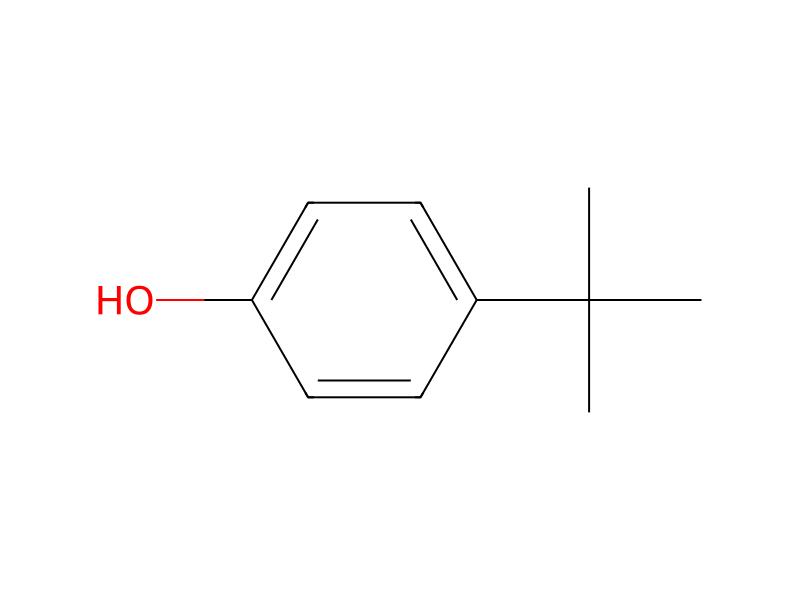
4-tert-Butylphenol → 1-Tert-butyl-4-propoxybenzene
HRID 2058849
Reaktionsgleichung

[Na].[C:2]([C:6]1[CH:11]=[CH:10][C:9]([OH:12])=[CH:8][CH:7]=1)([CH3:5])([CH3:4])[CH3:3].[CH2:13](Cl)[CH2:14][CH3:15]>C(O)C>[C:2]([C:6]1[CH:7]=[CH:8][C:9]([O:12][CH2:13][CH2:14][CH3:15])=[CH:10][CH:11]=1)([CH3:5])([CH3:3])[CH3:4]Komponenten
5
Edukt 3


Produkt 1

Reagenzien, Katalysatoren, Lösungsmittel 1

Versuchsvorschrift
Into 70 ml. of ethanol (absolute), 0.92 g. of sodium metal was dissolved and 6.0 g. (0.04 M) of 4-tert-butylphenol was added and then, 3.5 g. (0.044 M) of n-propylchloride was added. The mixture was refluxed for 20 hours and ethanol was distilled off and water was added. The reaction product was extracted with benzene and benzene layer was washed with 3% NaOH aqueous solution and with water and dehydrated over sodium sulfate and then, benzene was distilled off and a residue was distilled under a reduced pressure to obtain 4-tert-butyl-1-n-propoxybenzene. The product was dissolved into 6 ml. of glacial acetic acid and then, 12 ml. of fuming nitric acid (d=1.5) was added at 0° to 5° C. to react them for 1 hour and then, the reaction was continued at the ambient temperature for 1 hour at 35° to 40° C. for 4 hours. The reaction mixture was poured into ice water and the product was extracted with chloroform and washed with water, with 3% Na2CO3 aqueous solution and with water and dehydrated over sodium sulfate and chloroform was distilled off and the residue was recrystallized from ethanol to obtain 4.5 g. (43%) of a pale yellow crystal. (melting point of 106° to 107° C.)