StartseiteMCPWorkbenchSkills
StartseiteWorkbenchBenachrichtigungenMein Bereich
llms.txt · MCP-AnleitungDatenschutz · Nutzungsbedingungen · Supportv1.8.0
  1. Startseite
  2. /Reaktion

Dimethylformamide → 3-[3-[5-[[1-(tert-butoxycarbonyl)-2(S)-azetidinyl]methoxy]-3-pyridyl]phenyl]-1-propanol

HRID 2095315
Notizen
Druckvorschau

Reaktionsgleichung

Reaktionsgleichung von HRID 2095315
[C:1]([O:5][C:6]([N:8]1[CH2:11][CH2:10][C@H:9]1[CH2:12][O:13][C:14]1[CH:15]=[N:16][CH:17]=[C:18]([Sn](C)(C)C)[CH:19]=1)=[O:7])([CH3:4])([CH3:3])[CH3:2].I[C:25]1[CH:26]=[C:27]([CH2:31][CH2:32][CH2:33][OH:34])[CH:28]=[CH:29][CH:30]=1.CN(C=O)C.[F-].[Cs+]>[Cu]I.C1C=CC([P]([Pd]([P](C2C=CC=CC=2)(C2C=CC=CC=2)C2C=CC=CC=2)([P](C2C=CC=CC=2)(C2C=CC=CC=2)C2C=CC=CC=2)[P](C2C=CC=CC=2)(C2C=CC=CC=2)C2C=CC=CC=2)(C2C=CC=CC=2)C2C=CC=CC=2)=CC=1.CCOC(C)=O>[C:1]([O:5][C:6]([N:8]1[CH2:11][CH2:10][C@H:9]1[CH2:12][O:13][C:14]1[CH:19]=[C:18]([C:25]2[CH:26]=[C:27]([CH2:31][CH2:32][CH2:33][OH:34])[CH:28]=[CH:29][CH:30]=2)[CH:17]=[N:16][CH:15]=1)=[O:7])([CH3:4])([CH3:3])[CH3:2]
KomponentenReaktionsbedingungenVersuchsvorschriftAufarbeitungQuellen und NachweiseNotizen zur Reaktion

Komponenten

8

Edukt 4

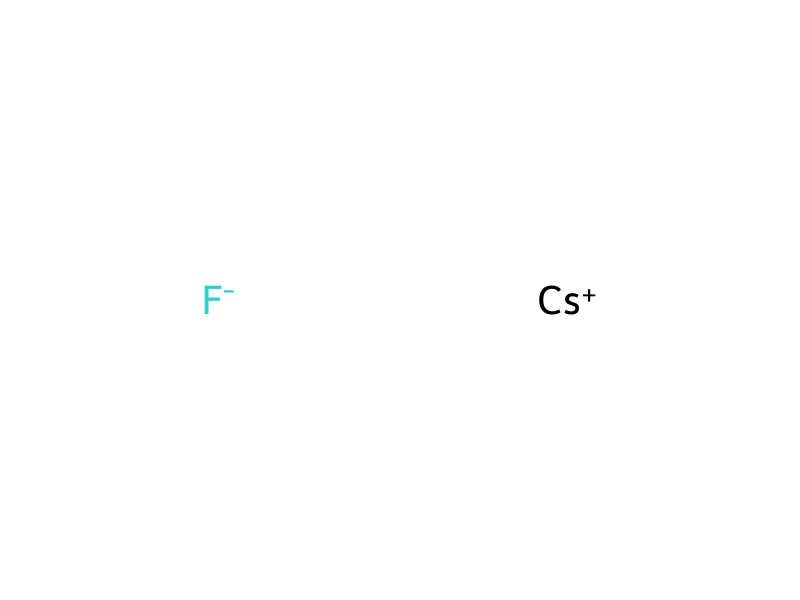
HCID 6228DimethylformamideHCID 25953Cesium fluorideHCID 105744715-Iodo-A-85380, 5-trimethylstannyl N-boc derivativeHCID 15169851Benzenepropanol, 3-iodo-

Produkt 1

HCID 593715313-[3-[5-[[1-(tert-butoxycarbonyl)-2(S)-azetidinyl]methoxy]-3-pyridyl]phenyl]-1-propanolAusbeute 83,3 %

Reagenzien, Katalysatoren, Lösungsmittel

3
HCID 24350Copper(1+) iodide; Copper(I) iodide; Cuprous iodide; Cuprous iodide (CuI)KatalysatorHCID 178418397HCID 178418397, VerbindungKatalysatorHCID 8857Ethyl AcetateLösungsmittel2×

Reaktionsbedingungen

Temperatur
50 °C

Versuchsvorschrift

3-[[1-(tert-Butoxycarbonyl)-2(S)-azetidinyl]methoxy]-5-(trimethylstannyl)pyridine (310 mg, 726 μmol), 3-(3-iodophenyl)-1-propanol (190 mg, 726 μmol), and anhydrous DMF (2.5 mL) were placed in a 50 mL round bottom flask with magnetic stirrer. To this mixture were added rapidly CsF (221 mg, 1.45 mmol, 2.0 equiv.), CuI (14 mg, 73 μmol, 0.1 equiv.), and tetrakis(triphenylphosphine)palladium(0) (42 mg, 36 μmol, 0.05 equiv.). The flask was fitted with a three-way stopcock with nitrogen balloon, and the atmosphere was exchanged. The reaction mixture was heated at 50° C. for 250 min. After this period of time, the TLC of an evaporated aliquot (SiO2, EtOAc) showed the absence of the aryl iodide and the formation of a new, polar spot. The bulk of solvent was pumped off at room temperature with an oil pump, and EtOAc was added to the residue, resulting in a solution and a precipitate. Both were loaded on a silica gel column (24×2.5 cm), which was eluted with EtOAc. Product-containing fractions were combined, evaporated, and evaporated with acetonitrile. The residue was taken up in acetonitrile and the solution was filtered from a small amount of wax over a cotton plug. The solution was again evaporated and the residue was taken up in DMSO (1 mL). Further purification was achieved by preparative HPLC in two portions on a Supelco Discovery C18 column (250×21.2 mm, 5 μm particle size; UV detection at 270 nm; flow 12.5 mL/min; gradient from 20 to 100% of acetonitrile in water within 50 min). The coupling product eluted as the main peak at tR approx. 25-27 min. The eluate was partially evaporated to remove acetonitrile, and the product was extracted from the residue with CH2Cl2 (3×10 mL). After drying over MgSO4, the combined organic phases were evaporated and dried (45° C./14 torr) to obtain 241 mg (83%) of the product as a glass. 1H NMR (CDCl3, TMS, 250 MHz) δ 8.45 (d, 1H, J=1.7 Hz), 8.31 (d, 1H, J=2.7 Hz), 7.46-7.34 (m, 4H), 7.29-7.22 (m, 1H), 4.55 (m, 1H), 4.40 (m, 1H), 4.21 (dd, 1H, J=2.9, 10.0 Hz), 3.92 (m, 2H), 3.72 (t, 2H, J=6.4 Hz), 2.80 (m, 2H), 2.47-2.24 (m, 2H), 2.21 (s, 1H, OH), 2.02-1.88 (m, 2H), 1.40 (s, 9H). 13C NMR (CDCl3, 62.5 MHz) δ 156.2, 155.2, 142.8, 140.8, 137.6, 137.5, 136.5 (br), 129.0, 128.4, 127.4, 124.8, 119.9, 79.7, 68.8, 61.9, 60.1, 47.1 (br), 34.2, 32.0, 28.3, 19.1. MS (EI) m/z 398 (M+, 4.1%), 243 (17%), 242 (34%), 100 (29%), 57 (100%), 56 (95%).


Aufarbeitung

  1. customThe flask was fitted with a three-way stopcock with nitrogen balloon
  2. waitAfter this period of time
  3. additionwas added to the residue
  4. customresulting in a solution
  5. washwas eluted with EtOAc
  6. customevaporated
  7. customevaporated with acetonitrile
  8. filtrationthe solution was filtered from a small amount of wax over a cotton plug
  9. customThe solution was again evaporated
  10. customFurther purification
  11. customwas achieved by preparative HPLC in two portions on a Supelco Discovery C18 column (250×21.2 mm, 5 μm particle size; UV detection at 270 nm; flow 12.5 mL/min; gradient from 20 to 100% of acetonitrile in water within 50 min)
  12. washThe coupling product eluted as the main peak at tR approx. 25-27 min
  13. customThe eluate was partially evaporated
  14. customto remove acetonitrile
  15. extractionthe product was extracted from the residue with CH2Cl2 (3×10 mL)
  16. dry with materialAfter drying over MgSO4
  17. customthe combined organic phases were evaporated
  18. customdried (45° C./14 torr)

Quellen und Nachweise

ORD-Eintrag
ord-341251ed4b774bff8ffded91b85d8c30
Quelldatensatz
uspto-grants-2013_05
DOI
10.6084/m9.figshare.5104873.v1
Patentnummer
US08445684B2

Notizen zur Reaktion

Wird geladen…

Auf dieser SeiteKomponentenReaktionsbedingungenVersuchsvorschriftAufarbeitungQuellen und NachweiseNotizen zur Reaktion