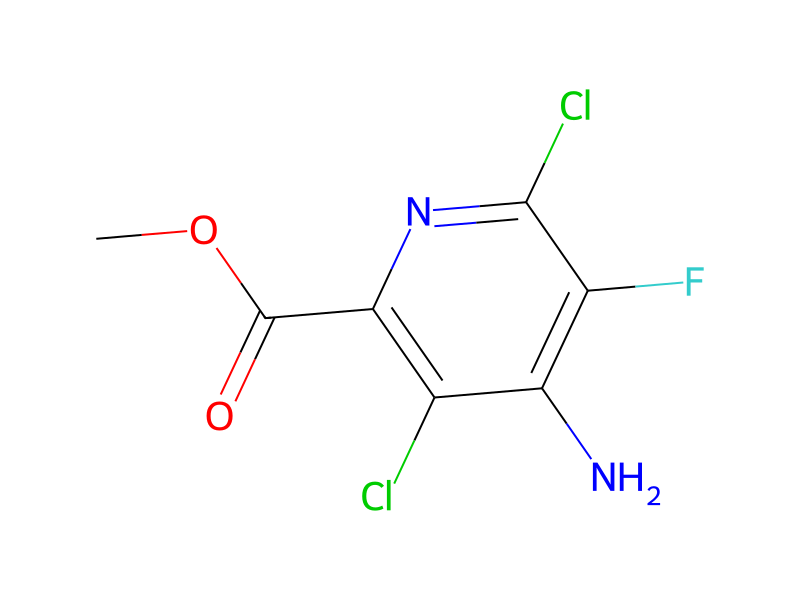
[NH2:1][C:2]1[C:7]([F:8])=[C:6](Cl)[N:5]=[C:4]([C:10]([O:12][CH3:13])=[O:11])[C:3]=1[Cl:14].[CH2:15]([Sn](CCCC)(CCCC)C=C)[CH2:16]CC.[F-].[Cs+]>CN(C)C=O.Cl[Pd](Cl)([P](C1C=CC=CC=1)(C1C=CC=CC=1)C1C=CC=CC=1)[P](C1C=CC=CC=1)(C1C=CC=CC=1)C1C=CC=CC=1>[NH2:1][C:2]1[C:7]([F:8])=[C:6]([CH:15]=[CH2:16])[N:5]=[C:4]([C:10]([O:12][CH3:13])=[O:11])[C:3]=1[Cl:14]A solution of methyl 4-amino-3,6-dichloro-5-fluoropyridine-2-carboxylate (8.00 g, 33.0 mmol), tributyl(vinyl)tin (13.27 g, 42.0 mmol) and cesium fluoride (11.19 g, 73.6 mmol) in dimethylformamide (250 mL) was sparged with nitrogen for 15 minutes. Dichlorobis(triphenylphosphine)palladium (II) (1.17 g, 1.6 mmol) was then added and the mixture was heated at 90° C. overnight. After cooling, the mixture was concentrated, taken up into ethyl acetate and filtered through a silica gel plug. The solvents were removed and the crude product was purified by column chromatography (50% ethyl acetate in hexane) to give methyl 4-amino-3-chloro-5-fluoro-6-vinylpyridine-2-carboxylate (5.13 g, 22.2 mmol), mp 68-71° C.