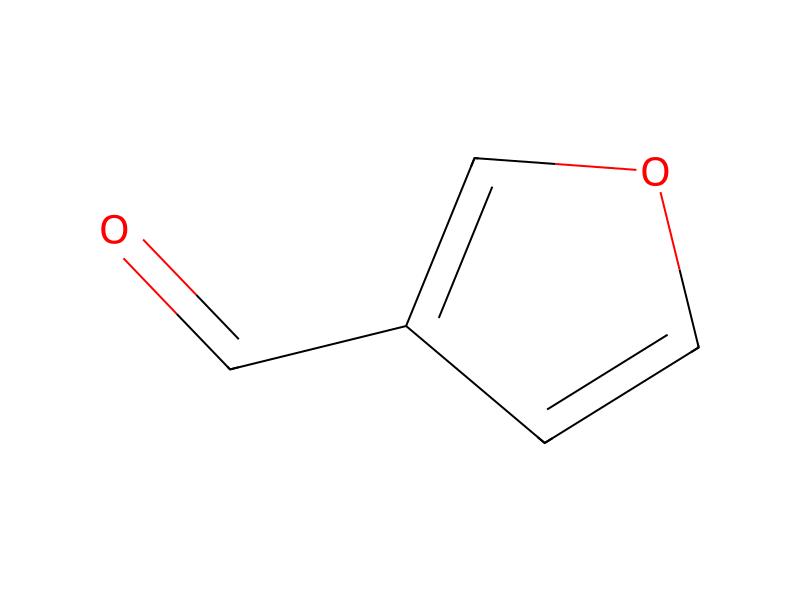
3-Furaldehyde → Furan, 3-(2,2-dibromoethenyl)-
Reaktionsgleichung

[C:1]([Br:5])(Br)(Br)[Br:2].C1(P(C2C=CC=CC=2)C2C=CC=CC=2)C=CC=CC=1.[O:25]1[CH:29]=[CH:28][C:27]([CH:30]=O)=[CH:26]1>C(Cl)Cl>[Br:2][C:1]([Br:5])=[CH:30][C:27]1[CH:28]=[CH:29][O:25][CH:26]=1Komponenten
5
Edukt 3


Produkt 1

Reagenzien, Katalysatoren, Lösungsmittel 1

Versuchsvorschrift
To a stirred and cooled (0° C.) solution of carbon tetrabromide (34.5 g, 104.1 mmol) in CH2Cl2 (70 mL) was added triphenylphosphine (54.6 g, 208.1 mmol) in five equal portions over a period of 5 nm. The resulting dark red solution was stirred for a further 10 min, and a solution of 3-furaldehyde (9) (5 g, 52.0 mmol) in CH2Cl2 (25 mL) was added slowly. The resulting black solution was allowed to warm to r.t. After 5.5 h the mixture was poured into ice-cold pentane and stirred vigourously. The mixture was filtered and the collected solid washed extensively with diethyl ether-ethyl acetate mixture. The combined solutions were washed with saturated aqueous Na2S2O3 (×1), water (×1), 1 M aqueous NaOH, saturated brine (×1), dried (MgSO4), filtered and concentrated. The residue was partially purified by silicagel chromatography (SGC) with hexane as eluent. Appropriate fractions were combined, concentrated and purified by vacuum distillation (150° C./0.5 mm Hg) to afford the dibromo-furan 10 (7.26 g, 55%) as a yellow oil. 1H NMR (400 MHz; CDCl3) δ 6.79 (m, 1H), 7.27 (m, 1H), 7.41 (m, 1H) and 7.83 (m, 1H).