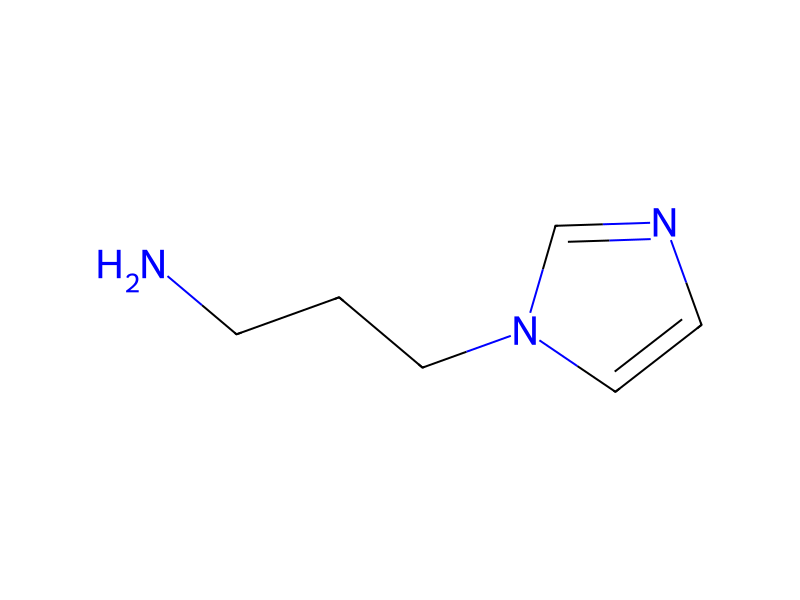
[Cl:1][C:2]1[CH:7]=[CH:6][C:5]([S:8]([NH:11][C:12]2[CH:20]=[CH:19][CH:18]=[CH:17][C:13]=2[C:14](Cl)=[O:15])(=[O:10])=[O:9])=[CH:4][CH:3]=1.[N:21]1([CH2:26][CH2:27][CH2:28][NH2:29])[CH:25]=[CH:24][N:23]=[CH:22]1.C(N(CC)CC)C.CN(C)C=O>O>[Cl:1][C:2]1[CH:7]=[CH:6][C:5]([S:8]([NH:11][C:12]2[CH:20]=[CH:19][CH:18]=[CH:17][C:13]=2[C:14]([NH:29][CH2:28][CH2:27][CH2:26][N:21]2[CH:25]=[CH:24][N:23]=[CH:22]2)=[O:15])(=[O:10])=[O:9])=[CH:4][CH:3]=12-(4-Chlorobenzenesulphonamido)benzoyl chloride (3.40 g) was added in portions to a stirred mixture of 3-imidazol-1-ylpropylamine (1.29 g), triethylamine (1.04 g) and dimethylformamide (25 ml) at room temperature. The temperature of the mixture rose to 33° C.; the mixture was then stirred at room temperature for 4 hours before pouring into water (500 ml). The aqueous solution was decanted from the crude product which had precipitated as a gum. This gummy material was dissolved in dichloromethane (50 ml), the solution was dried over magnesium sulphate and the solution was evaporated. The crude product was recrystallised from ethyl acetate to give 2-(4-chlorobenzenesulphonamido)-N-(3-imidazol-1-ylpropyl)benzamide, in the form of a white solid, m.p. 175°-177° C. (yield: 2.1 g).