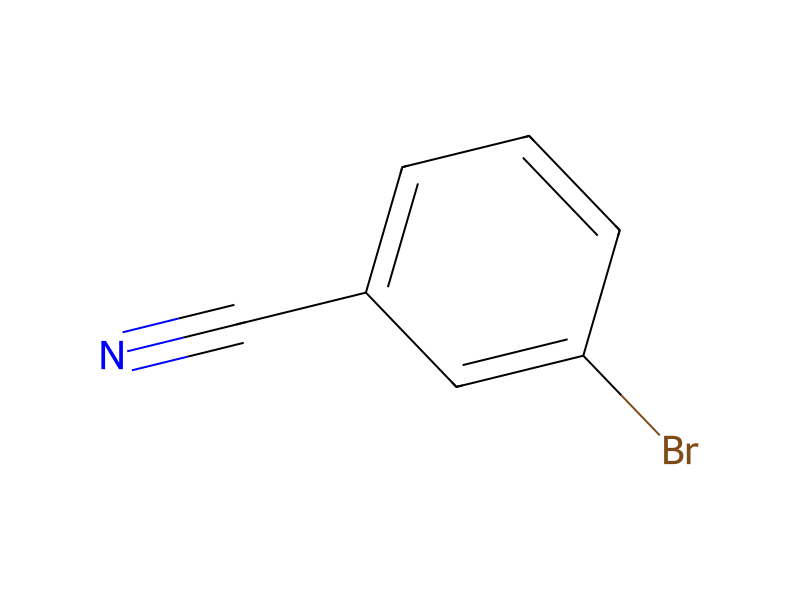
Br[C:2]1[CH:3]=[C:4]([CH:7]=[CH:8][CH:9]=1)[C:5]#[N:6].[CH2:10]([Sn](CCCC)(CCCC)CC=C)[CH2:11][CH2:12]C.[Li+].[Cl-]>C1(C)C=CC=CC=1.C1C=CC([P]([Pd]([P](C2C=CC=CC=2)(C2C=CC=CC=2)C2C=CC=CC=2)([P](C2C=CC=CC=2)(C2C=CC=CC=2)C2C=CC=CC=2)[P](C2C=CC=CC=2)(C2C=CC=CC=2)C2C=CC=CC=2)(C2C=CC=CC=2)C2C=CC=CC=2)=CC=1>[CH2:12]([C:2]1[CH:3]=[C:4]([CH:7]=[CH:8][CH:9]=1)[C:5]#[N:6])[CH:11]=[CH2:10]To solution of compound 3-bromobenzonitrile (5 g, 27 mmol) and tributyl(prop-2-en-1-yl)stannane (13.5 g, 41.2 mmol) in toluene was added Pd(PPh3)4 (300 mg) and LiCl (2.3 g, 54 mmol) under N2, and then the mixture was stirred at reflux for 18 h. The reaction mixture was quenched by the addition of water. Extracted the mixture with EtOAc and the organic layer was dried and concentrated. The residue was purified by a flash column chromatography to afford 3-(prop-2-en-1-yl)benzonitrile. 1H-NMR (300 MHz, CDCl3) δ 7.32˜7.82 (m, 4H), 5.85˜6.00 (m, 1H), 5.05˜5.17 (m, 2H), 3.42 (d, J=6.8 Hz, 2H).