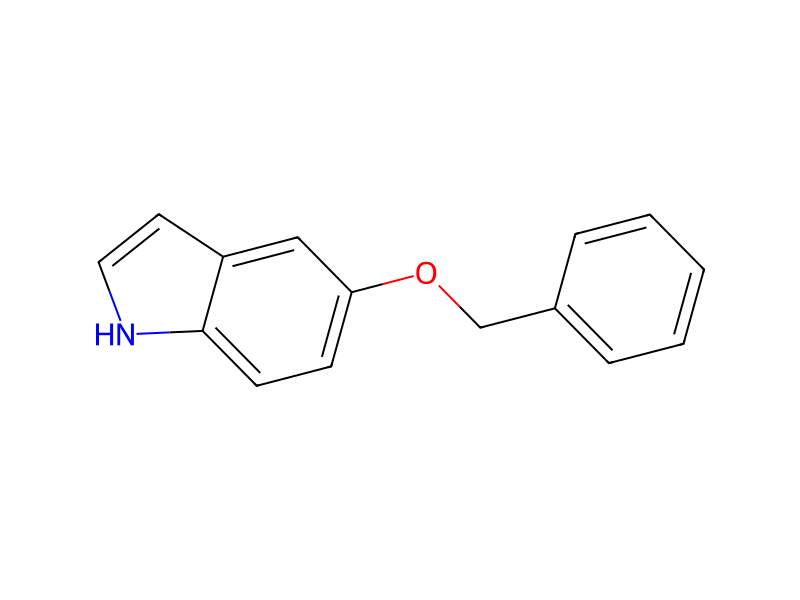
5-Benzyloxyindole (7) (8.81 g, 39.5 mmol, 1.0 equiv., supplied by Combi-Blocks) was dissolved in anhydrous DMF (100 mL) and the solution was cooled to 0° C. Dry sodium hydride (1.89 g, 78.9 mmol, 2.0 equiv.) was added slowly. The mixture was warmed to room temperature over 30 minutes. 2-Pentyl-tosylate was added dropwise. The mixture was stirred for 18 h. Water was added slowly (dropwise at first) to quench excess NaH. The resulting mixture was extracted once with ether, and then washed with water and brine, respectively. The organic phase was dried with MgSO4, and concentrated on a rotary evaporator to yield a crude oil. The crude product was purified by flash column chromatography (3:1 hexanes/ethyl acetate) to yield 5-(benzyloxy)-1-(pentan-2-yl)-1H-indole (8) as an amber oil (10.67 g) of approximately 90% purity, which was used in the next step without any further purification. 1H NMR (500 MHz, CDCl3) δ7.50 (d, J=7.3 Hz, 2H), 7.40 (t, J=7.3 Hz, 2H), 7.34 (d, J=7.3 Hz, 1H), 7.29 (d, J=9.0 Hz, 1H), 7.17 (dd, J=8.9, 2.4 Hz, 1H), 6.96 (dd, J=8.9, 2.4 Hz, 1H), 6.44 (d, J=3.1 Hz, 1H), 5.12 (s, 2H), 4.44 (m, 1H), 1.88 (m, 1H), 1.77 (m, 1H), 1.50 (d, J=6.8 Hz, 3H), 1.23 (m, 2H), 0.89 (t, J=7.4 Hz, 3H).