Reaktionsgleichung

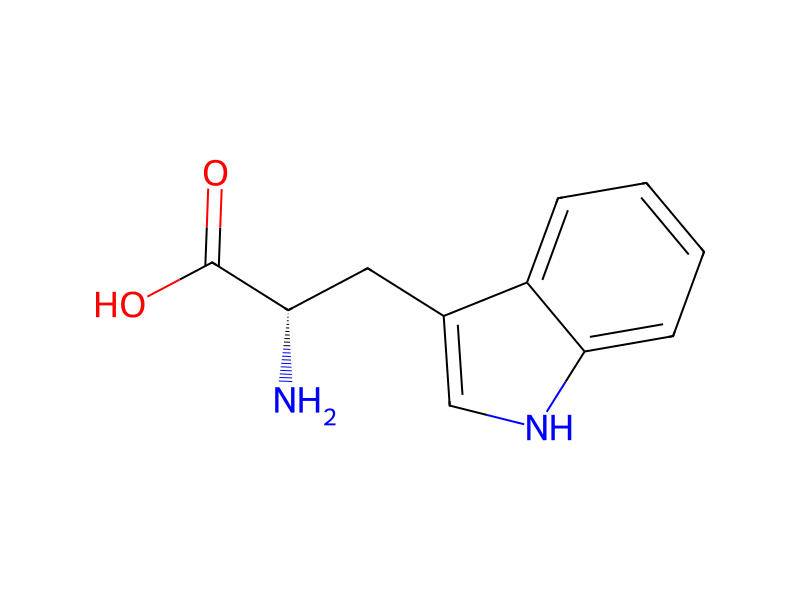
N[C@H:2]([C:13]([OH:15])=[O:14])[CH2:3][C:4]1[C:12]2[C:7](=[CH:8][CH:9]=[CH:10][CH:11]=2)[NH:6][CH:5]=1.N[C@@H](C(O)=[O:29])CC1C2C(=CC=CC=2)NC=1.NC(C(O)=O)CC1C2C(=CC=CC=2)NC=1>>[NH:6]1[C:7]2[C:12](=[CH:11][CH:10]=[CH:9][CH:8]=2)[C:4]([CH2:3][C:2](=[O:29])[C:13]([OH:15])=[O:14])=[CH:5]1Komponenten



Versuchsvorschrift
The “amino acid oxidase activity” for reaction 1 means an activity catalyzing the reaction shown in scheme (13). Generally, L-amino acid oxidase generates keto acid from the corresponding L-amino acid, while D-amino acid oxidase generates keto acid from the corresponding D-amino acid. Specifically, in accordance with the present invention, individually, a microorganism having L-amino acid oxidase activity may be used when L-tryptophan is used as the raw material, while a microorganism having D-amino acid oxidase activity may used when D-tryptophan is used as the raw material. Additionally, the preparation from DL-tryptophan is also applicable. When D- and L-amino acid oxidase is allowed to interact with DL-tryptophan, the intended indole-3-pyruvic acid may be quantitatively produced. When D- or L-amino acid oxidase interacts with DL-tryptophan, otherwise, the intended indole-3-pyruvic acid may be produced at a yield of 50%.
Quellen und Nachweise
- ORD-Eintrag
- ord-dc9d53b830aa46518adc2692f5162c24
- Quelldatensatz
- uspto-grants-2012_06
- Patentnummer
- US08202711B2
Verknüpfte Notizen
Wird geladen…