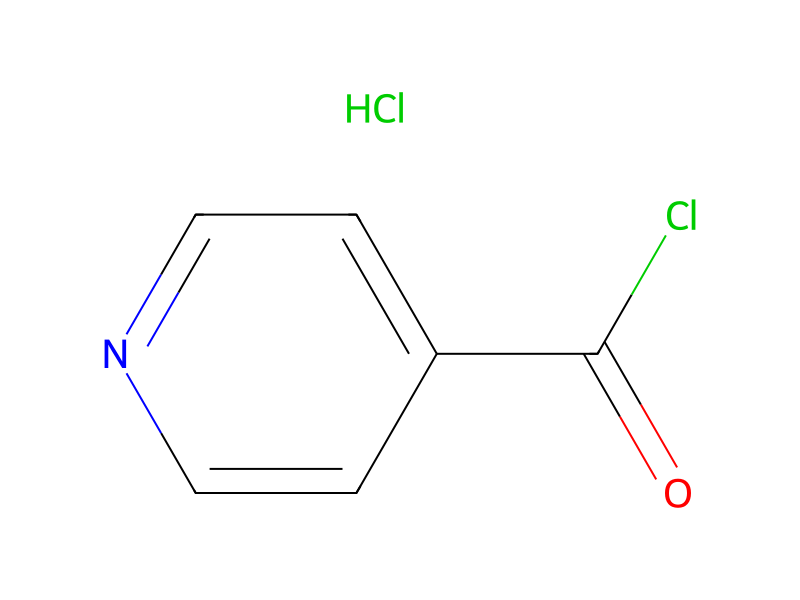
Cl.[C:2](Cl)(=[O:9])[C:3]1[CH:8]=[CH:7][N:6]=[CH:5][CH:4]=1.C(N(CC)CC)C.ClCCl.[NH2:21][C:22]1[CH:27]=[C:26]([C:28]([F:31])([F:30])[F:29])[CH:25]=[CH:24][C:23]=1[N:32]1[CH2:37][CH2:36][O:35][CH2:34][CH2:33]1>O>[N:32]1([C:23]2[CH:24]=[CH:25][C:26]([C:28]([F:29])([F:31])[F:30])=[CH:27][C:22]=2[NH:21][C:2](=[O:9])[C:3]2[CH:8]=[CH:7][N:6]=[CH:5][CH:4]=2)[CH2:37][CH2:36][O:35][CH2:34][CH2:33]1Isonicotinoyl chloride hydrochloride (320 mg, 1.80 mmol, commercially available product) and triethylamine (480 μl, 3.44 mmol) were sequentially added at 0° C. to a dichloromethane (5 ml) solution of 4-[2-amino-4-(trifluoromethyl)phenyl]morpholine (196 mg, 0.796 mmol), obtained as described in Referential Example 5-2. The resulting mixture was warmed to room temperature and stirred for 60 hours. Water was added to the mixture, and the resulting mixture was extracted three times with dichloromethane. The obtained organic layer was washed with a saturated sodium chloride solution, dried over anhydrous sodium sulfate, filtered, and concentrated under reduced pressure. The residue was purified by silica gel column chromatography (30 g, hexane/ethyl acetate=2/1). Thus, N-[2-(4-morpholinyl)-5-(trifluoromethyl)phenyl]isonicotinamide (GIF-0346) (65.1 mg, 23.2%) was yielded as a colorless solid.