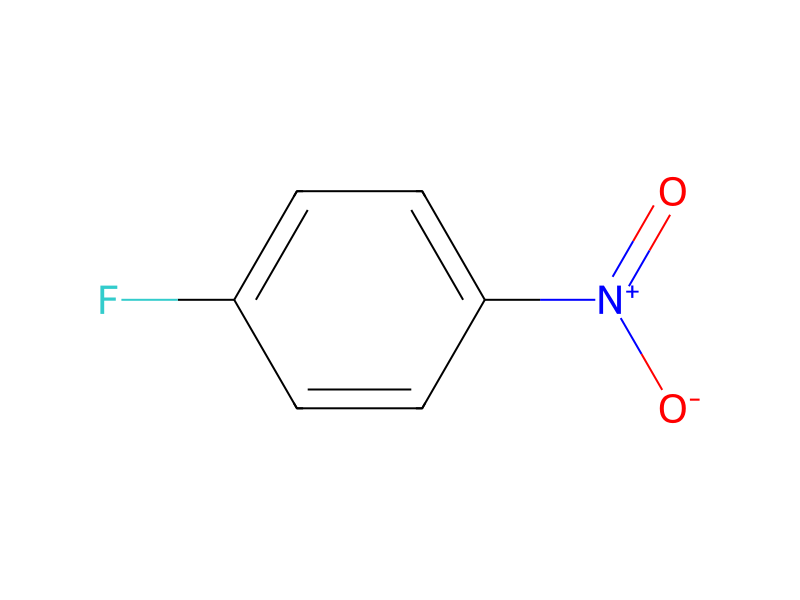
[CH3:1][N:2]1[CH2:7][CH:6]2[CH2:8][CH:3]1[CH2:4][NH:5]2.F[C:10]1[CH:15]=[CH:14][C:13]([N+:16]([O-:18])=[O:17])=[CH:12][CH:11]=1.C(N(CC)C(C)C)(C)C>C(#N)C>[CH3:1][N:2]1[CH2:7][CH:6]2[CH2:8][CH:3]1[CH2:4][N:5]2[C:10]1[CH:15]=[CH:14][C:13]([N+:16]([O-:18])=[O:17])=[CH:12][CH:11]=1A solution of 2-methyl-2,5-diaza-bicyclo[2.2.1]heptane (0.4402 g, 1.6 mmol), p-fluoro-nitrobenzene (0.56 mL, 5.4 mmol), N,N-diisopropylethylamine (0.84 mL, 4.82 mmol) in 5 mL of acetonitrile is heated at 100° C. overnight. After the solvent is removed, the residue is treated with saturated sodium bicarbonate solution and extracted with chloroform. The organic layer is washed with brine, dried over magnesium sulfate, filtered, and evaporated to dryness. The oil is washed with hexane to give a yellow solid, which is recrystallized from ethyl acetate/hexane to yield 0.246 g (65% yield) of 2-methyl-5-(4-nitro-phenyl)-2,5-diaza-bicyclo[2.2.1]heptane.