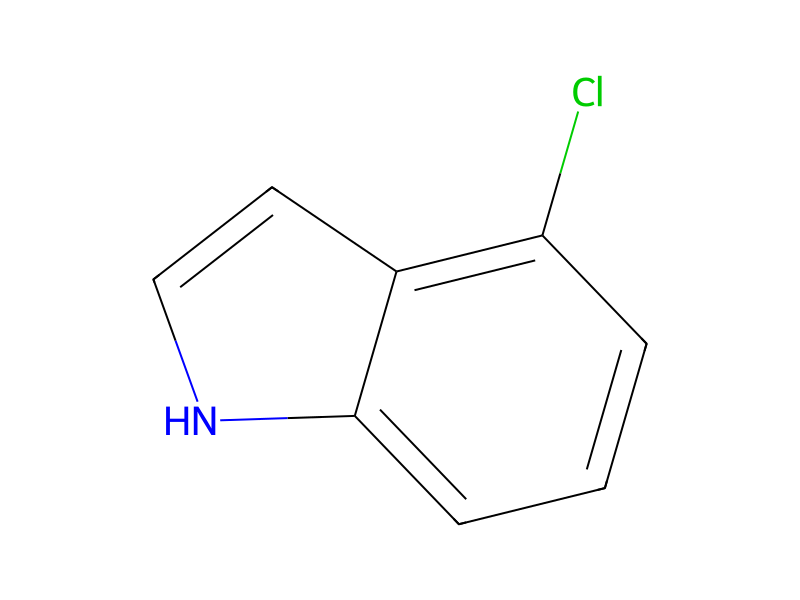
[Cl:1][C:2]1[CH:7]=[CH:6][CH:5]=[CH:4][C:3]=1[CH:8]([C:15]1[CH:20]=[CH:19][C:18]([Cl:21])=[CH:17][CH:16]=1)[N:9]1[CH2:14][CH2:13][NH:12][CH2:11][CH2:10]1.C=O.[Cl:24][C:25]1[CH:33]=[CH:32][CH:31]=[C:30]2[C:26]=1[CH:27]=[CH:28][NH:29]2.[C:34](=O)(O)[O-].[Na+]>O1CCOCC1.C(O)(=O)C>[Cl:24][C:25]1[CH:33]=[CH:32][CH:31]=[C:30]2[C:26]=1[C:27]([CH2:34][N:12]1[CH2:11][CH2:10][N:9]([CH:8]([C:15]3[CH:16]=[CH:17][C:18]([Cl:21])=[CH:19][CH:20]=3)[C:3]3[CH:4]=[CH:5][CH:6]=[CH:7][C:2]=3[Cl:1])[CH2:14][CH2:13]1)=[CH:28][NH:29]2A stirred solution of 0.4 gram (0.001 mole) of N′-[(2-chlorophenyl)(4-chlorophenyl)methyl]piperazine in 1 mL of dioxane was cooled to 0° C. To this was added 2 mL of glacial acetic acid followed by 0.14 mL of 37% aqueous formaldehyde. A solution of 0.2 gram (0.001 mole) of 4-chloroindole in 1 mL of dioxane was then slowly added. Upon completion of the addition the reaction mixture was warmed to ambient temperature where it stirred for five hours. The reaction mixture was then cooled to 0° C., neutralized with aqueous saturated sodium bicarbonate solution, and extracted with two portions of diethyl ether. The combined extracts were washed with an aqueous saturated sodium chloride solution and dried with sodium sulfate, yielding 0.6 gram of crude material. The crude material was purified by preparative TLC. Elution was accomplished with 3:2 ethyl acetate: methylene chloride. The product-containing fractions were combined and concentrated under reduced pressure, yielding 0.4 gram of N-(4-chloroindol-3-ylmethyl)-N′-[(4-chlorophenyl)(2-chlorophenyl)methyl]piperazine. The NMR spectrum was consistent with the proposed structure.