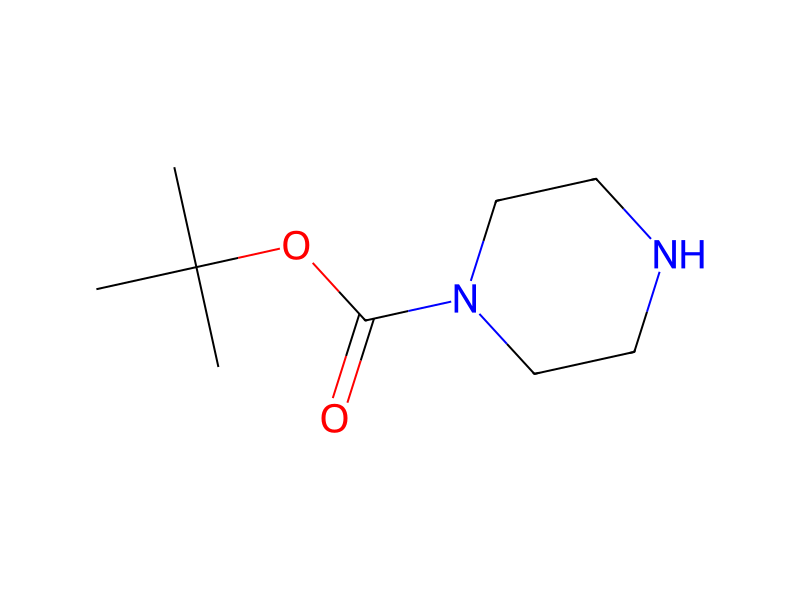
C(=O)(O)[O-].[K+].[F:6][C:7]1[C:13](F)=[CH:12][C:10]([NH2:11])=[C:9]([N+:15]([O-:17])=[O:16])[CH:8]=1.[C:18]([O:22][C:23]([N:25]1[CH2:30][CH2:29][NH:28][CH2:27][CH2:26]1)=[O:24])([CH3:21])([CH3:20])[CH3:19].O>CN(C=O)C>[C:18]([O:22][C:23]([N:25]1[CH2:30][CH2:29][N:28]([C:13]2[CH:12]=[C:10]([NH2:11])[C:9]([N+:15]([O-:17])=[O:16])=[CH:8][C:7]=2[F:6])[CH2:27][CH2:26]1)=[O:24])([CH3:21])([CH3:19])[CH3:20]2.4 g of potassium bicarbonate and 1 g of 4,5-difluoro-2-nitroaniline are added to a solution of 3.3 g of piperazine-1-carboxylic acid tert-butyl ester in 30 mL of anhydrous DMF. The reaction medium is heated at 60° C. using an oil bath for 30 minutes. The reaction medium is cooled to ambient temperature, then 150 mL of water are added thereto, and precipitation occurs. The precipitate is filtered off through sintered glass. The solid is dried in an oven at 50° C. 1.4 g of 4-(5-amino-2-fluoro-4-nitrophenyl)piperazine-1-carboxylic acid tert-butyl ester are obtained in the form of a yellow solid. 1H NMR (300 MHz, DMSO-d6, δ in ppm): 1.42 (s, 9H); 3.14 (m, 4H); 3.46 (m, 4H); 6.43 (d, J=8.0 Hz, 1H); 7.36 (broad s, 2H); 7.66 (d, J=14.5 Hz, 1H). EI mass spectrum: m/z=340 M+., m/z=284 (M−C4H+., m/z=264 (m/z=284−HF)+, m/z=57 C4H+ (base peak).