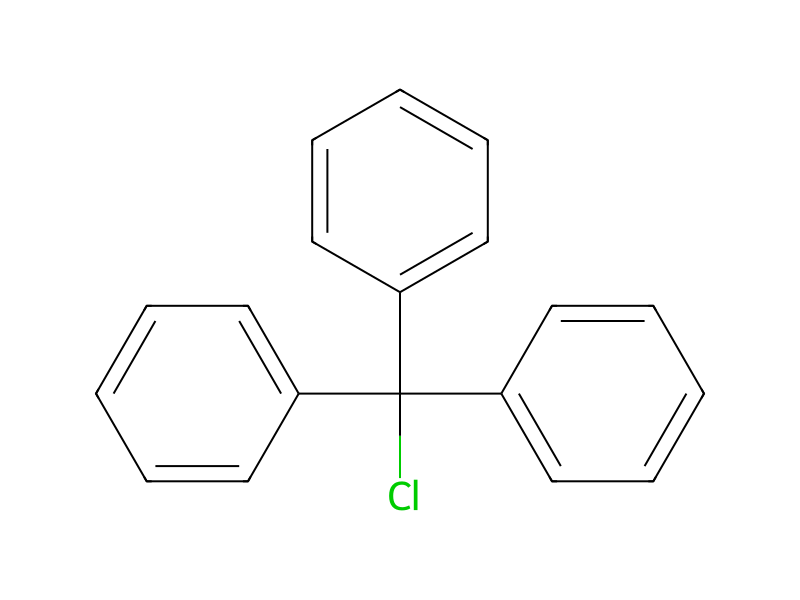
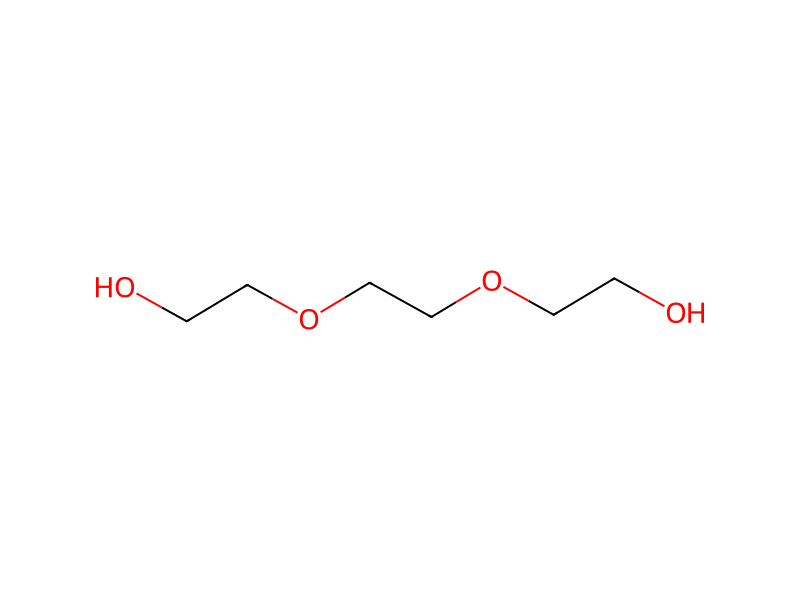
[CH2:1]([OH:10])[CH2:2][O:3][CH2:4][CH2:5][O:6][CH2:7][CH2:8][OH:9].CCN(CC)CC.[C:18](Cl)([C:31]1[CH:36]=[CH:35][CH:34]=[CH:33][CH:32]=1)([C:25]1[CH:30]=[CH:29][CH:28]=[CH:27][CH:26]=1)[C:19]1[CH:24]=[CH:23][CH:22]=[CH:21][CH:20]=1>C(Cl)Cl>[C:18]([O:10][CH2:1][CH2:2][O:3][CH2:4][CH2:5][O:6][CH2:7][CH2:8][OH:9])([C:19]1[CH:24]=[CH:23][CH:22]=[CH:21][CH:20]=1)([C:31]1[CH:32]=[CH:33][CH:34]=[CH:35][CH:36]=1)[C:25]1[CH:26]=[CH:27][CH:28]=[CH:29][CH:30]=1To a CH2Cl2 (300 mL) solution of triethylene glycol (21 g, 140 mmol) was added Et3N (20 mL, 140 mmol); then trityl chloride (19.5 g, 70 mmol) in CH2Cl2 (100 mL) was added dropwise at 0° C. The mixture was stirred overnight and quenched with H2O. The organic phase was washed with H2O and brine successively, concentrated through rotary evaporation, and subjected to silica gel chromatography using hexane/EtOAc as the eluent to afford compound 21 (21 g, 53.6 mmol, 77% yield) as a clear liquid: 1H NMR (500 MHz, CDCl3) δ 7.47-7.46 (m, 6H), 7.28 (t, J=7.0 Hz, 6H), 7.21 (t, J=7.0 Hz, 3H), 3.68 (s, 8H), 3.60 (br, 2H), 3.25 (br, 2H), 2.57 (br, 1H); 13C NMR (126 MHz, CDCl3) δ 144.2, 128.8, 127.9, 127.1, 86.8, 72.7, 71.0, 70.8, 70.7, 63.4, 61.9; MS (ESI) m/z 415 (M+Na)+.