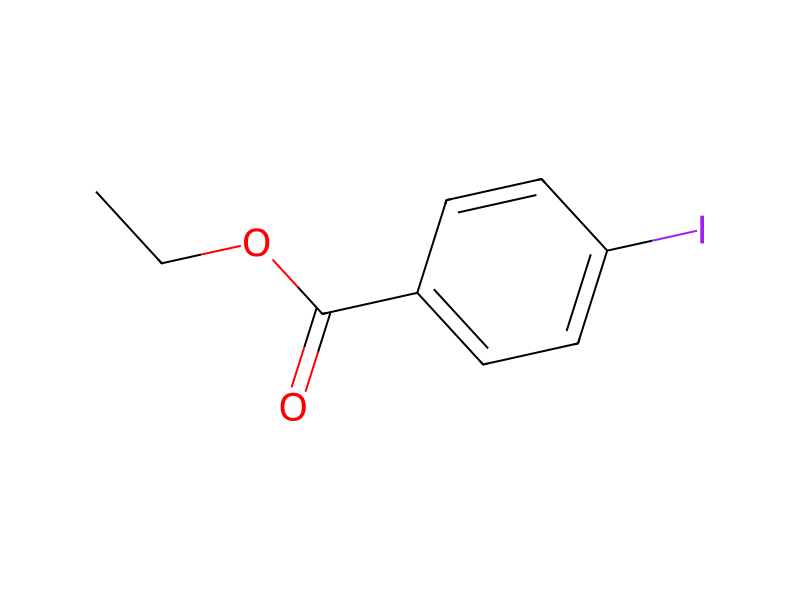
[C:1]([C:3]1([OH:11])[CH:8]2[CH2:9][CH2:10][N:5]([CH2:6][CH2:7]2)[CH2:4]1)#[CH:2].I[C:13]1[CH:23]=[CH:22][C:16]([C:17]([O:19][CH2:20][CH3:21])=[O:18])=[CH:15][CH:14]=1.C(N(CC)CC)C>C1C=CC(P(C2C=CC=CC=2)C2C=CC=CC=2)=CC=1.C1C=CC(P(C2C=CC=CC=2)C2C=CC=CC=2)=CC=1.Cl[Pd]Cl.[Cu]I.CN(C)C=O>[CH2:20]([O:19][C:17]([C:16]1[CH:22]=[CH:23][C:13]([C:2]#[C:1][C:3]2([OH:11])[CH:8]3[CH2:9][CH2:10][N:5]([CH2:6][CH2:7]3)[CH2:4]2)=[CH:14][CH:15]=1)=[O:18])[CH3:21]A mixture of 3-ethynyl-3-hydroxyquinuclidine (604 mg), ethyl 4-iodobenzoate (1.1 g), bis(triphenylphosphine)-palladium (II) chloride (140 mg), copper (I) iodide (70 mg) and anhydrous triethylamine (4 ml) and anhydrous dimethylformamide (8 ml) was stirred under an atmosphere of argon. The reaction mixture was heated at 65° C. for 18 hours. The reaction mixture was cooled and the triethylamine and dimethylformamide removed by evaporation. To the residue was added 2M sodium hydroxide (25 ml) and the mixture extracted with dichloromethane. The organic phase was washed with water, saturated brine and dried (MgSO4). Evaporation gave a solid which was crystallised from acetonitrile to give 3-[2-(4-ethoxycarbonylphenyl)ethynyl]-3-hydroxyquinuclidine (553 mg) as a colourless solid, m.p. 176°-177° C.; microanalysis, found: C, 72.2; H, 7.3; N, 4.8%; C18H21NO3 requires: C, 72.2; H, 7.07; N, 4.68%; NMR (DMSO-d6): 1.32(3H, t), 1.49-2.01(5H, m), 2.68(4H, t), 2.78-3.14(2H, d of d), 4.32(2H, q), 5.66(1H, br.s), 7.49-7.58(2H, d) and 7.90-7.98(2H, d); m/Z 300 (M+H).