Reaktionsgleichung

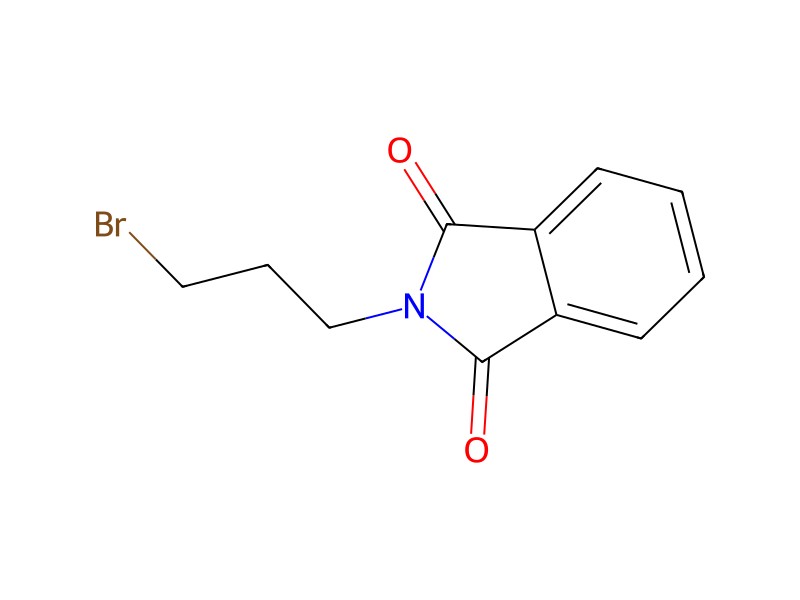
[C:1]1([NH:7][C:8]2[CH:13]=[CH:12][CH:11]=[CH:10][N:9]=2)[CH:6]=[CH:5][CH:4]=[CH:3][CH:2]=1.[H-].[Na+].[H][H].Br[CH2:19][CH2:20][CH2:21][N:22]1[C:26](=[O:27])[C:25]2=[CH:28][CH:29]=[CH:30][CH:31]=[C:24]2[C:23]1=[O:32]>CS(C)=O.O>[C:1]1([N:7]([CH2:19][CH2:20][CH2:21][N:22]2[C:26](=[O:27])[C:25]3=[CH:28][CH:29]=[CH:30][CH:31]=[C:24]3[C:23]2=[O:32])[C:8]2[CH:13]=[CH:12][CH:11]=[CH:10][N:9]=2)[CH:2]=[CH:3][CH:4]=[CH:5][CH:6]=1Komponenten
7






Reaktionsbedingungen
- Temperatur
- 85 °C
Versuchsvorschrift
A solution of 2-(N-phenylamino)pyridine (5.0 g) in DMSO (15 ml) was added to a suspension of sodium hydride (0.78 g) in DMSO (20 ml). The mixture was stirred and slowly heated under nitrogen to 85° C. After the evolution of hydrogen had ceased, the mixture was cooled to room temperature and a solution of N-(3-bromopropyl)phthalimide (7.88 g) in DMSO (15 ml) added dropwise. The mixture was allowed to stand overnight and then poured into water. The aqueous phase was made acid to a pH between 2 to 4 and extracted with ether. The extracts were dried (MgSO4), the ether evaporated and the residue crystallised from ethanol to give N-[3-(N-phenyl-N-pyrid-2-ylamino)propyl]phthalimide, 3.69 g (35%) m.p. 103°-105° C.
Aufarbeitung
- temperaturethe mixture was cooled to room temperature
- extractionextracted with ether
- dry with materialThe extracts were dried (MgSO4)
- customthe ether evaporated
- customthe residue crystallised from ethanol
Quellen und Nachweise
- ORD-Eintrag
- ord-ef1965a29c304b348a573de56f31640e
- Quelldatensatz
- uspto-grants-1987_09
- Patentnummer
- US04692456
Verknüpfte Notizen
Wird geladen…