Reaktionsgleichung

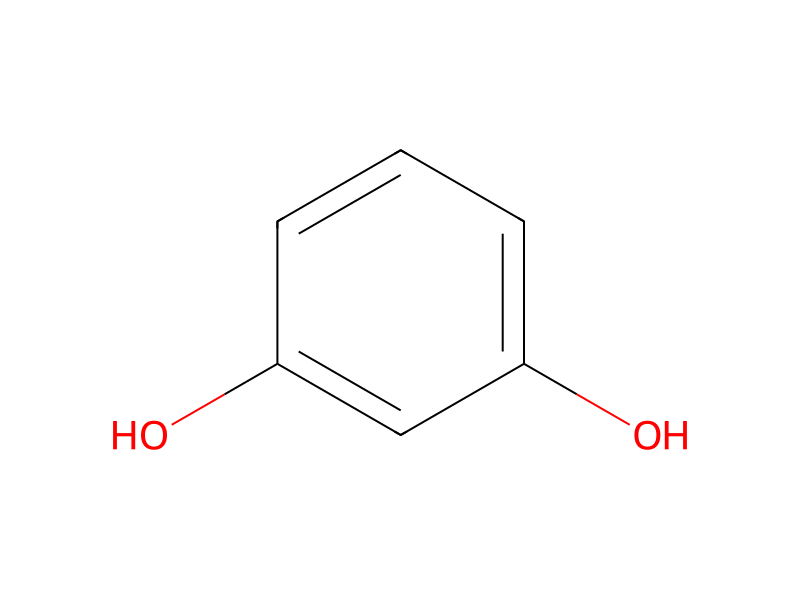
[OH-:1].[Na+].[CH2:3]1[CH2:8][O:7][CH:6]=[CH:5][CH2:4]1.OOO.[CH:12]([C:15]1[CH:20]=[CH:19][CH:18]=[C:17](C(C)C)[CH:16]=1)(C)C.C1C[O:28]C=CC1.OOO.C(C1C=CC=C(C(C)C)C=1)(C)C>>[C:8]1([CH:3]=[CH:4][CH:5]=[C:6]([OH:7])[CH:12]=1)[OH:1].[C:20]1([CH:15]=[CH:16][C:17]([OH:28])=[CH:18][CH:19]=1)[OH:1]Komponenten





Reaktionsbedingungen
- Temperatur
- 80 °C
Versuchsvorschrift
One commercial process, believed to be practiced by the Sumitomo Chemical Company, Ltd. is described in part by Suda et al. U.S. Pat. No. 3,953,521, British Patent Specification No. 921,557, Suda et al. U.S. Pat. No. 3,950,431, Suda et al. U.S. Pat. No. 3,923,908, Suda et al. U.S. Pat. No. 3,928,469, and Japanese Pat. No. 61-327 and Japanese Kokai No. 58-88357. The Sumitomo process involves the continuous production of m- and p-DHP by hydroperoxidation of m- and p-DIPB in liquid phase using an alkali catalyst, such as 10-20 vol % of a 2% sodium hydroxide (NaOH) solution at 95°-115° C. and air at a pressure within the range of atmospheric to 10 atmospheres. The hydroperoxidation product is extracted with a 4% aqueous sodium hydroxide solution to separate DHP and m-diisopropylbenzene hydroxyhydroperoxide (HHP) from unreacted m-DIPB and diisopropylbenzene monohydroperoxide (MHP). The MHP/m-DIPB fraction is recycled to the hydroperoxidation reaction vessel. The DHP/HHP fraction, in the form of an aqueous solution containing sodium salts of DHP and HHP, is heated to 80° C. and extracted with methyl isobutyl ketone (MIBK) to recover DHP and HHP. The MIBK solution of DHP/HHP is then washed with an organic solvent to reduce the HHP content, and mixed with an acid catalyst, such as 0.5-2% concentrated sulfuric acid (H2SO4) and, in some instances, hydrogen peroxide (H2O2) to decompose the DHP to either resorcinol or hydroquinone and acetone. The decomposition product is then neutralized with an aqueous ammonia solution, then distilled to obtain crude resorcinol or hydroquinone. Methods for purifying the crude resorcinol are described in Suda et al. U.S. Pat. Nos. 3,929,920; 3,911,030, and 3,969,420, and Japan Kokai No. 78-53626 and British Pat. No. 2,061,926 A.
Aufarbeitung
- customat 95°-115° C.
- extractionThe hydroperoxidation product is extracted with a 4% aqueous sodium hydroxide solution
- customto separate DHP and m-diisopropylbenzene hydroxyhydroperoxide (HHP) from unreacted m-DIPB and diisopropylbenzene monohydroperoxide (MHP)
- customThe MHP/m-DIPB fraction is recycled to the hydroperoxidation reaction vessel
- extractionextracted with methyl isobutyl ketone (MIBK)
- customto recover DHP and HHP
- washThe MIBK solution of DHP/HHP is then washed with an organic solvent
- additionmixed with an acid catalyst, such as 0.5-2% concentrated sulfuric acid (H2SO4) and, in some instances, hydrogen peroxide (H2O2)
- distillationdistilled
Quellen und Nachweise
- ORD-Eintrag
- ord-5105673d000f4b2bbba87cabfe2504eb
- Quelldatensatz
- uspto-grants-1989_07
- Patentnummer
- US04849549
Verknüpfte Notizen
Wird geladen…