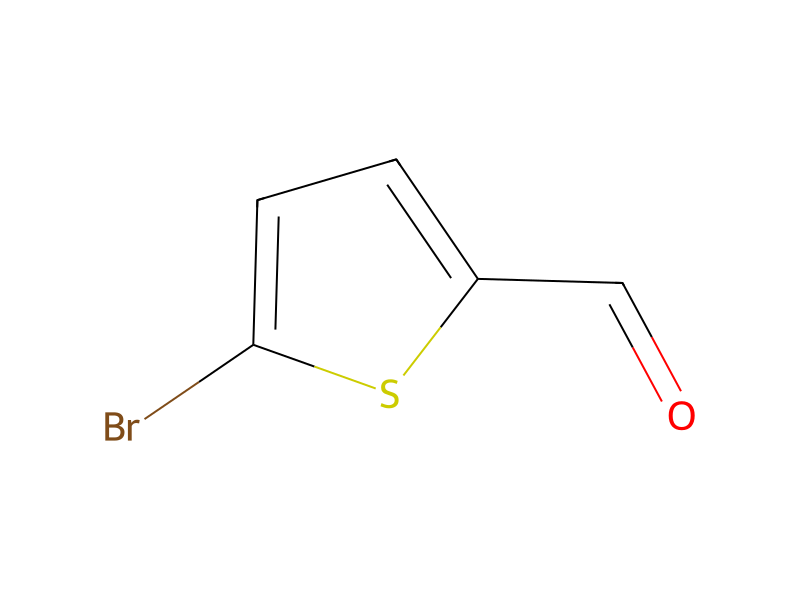
Br[C:2]1[S:6][C:5]([CH:7]=[O:8])=[CH:4][CH:3]=1.[CH3:9][C:10]1[CH:11]=[C:12](B(O)O)[CH:13]=[CH:14][CH:15]=1>COCCOC.C(O)C.C([O-])([O-])=O.[Na+].[Na+].[Pd].C1(P(C2C=CC=CC=2)C2C=CC=CC=2)C=CC=CC=1.C1(P(C2C=CC=CC=2)C2C=CC=CC=2)C=CC=CC=1.C1(P(C2C=CC=CC=2)C2C=CC=CC=2)C=CC=CC=1.C1(P(C2C=CC=CC=2)C2C=CC=CC=2)C=CC=CC=1>[CH3:9][C:10]1[CH:15]=[C:14]([C:2]2[S:6][C:5]([CH:7]=[O:8])=[CH:4][CH:3]=2)[CH:13]=[CH:12][CH:11]=15-Bromo-2-thiophenecarboxaldehyde (5.09 g, 26.2 mmol) was added to a suspension of 907 mg (0.78 mmol) of tetrakis(triphenylphosphine) palladium (0) in 50 mL of DME, and the resulting mixture was stirred at room temperature for 15 min. To this mixture was added a solution of the 3-methylphenyl boronic acid (prepared above) in 10 mL of ethanol and 26 mL of 2M aqueous Na2CO3. The reaction was stirred at reflux for 24 hours, then cooled to room temperature, diluted, and extracted with ether. The organic extract was washed with water and brine, dried over MgSO4, and concentrated. The residue was purified by flash chromatography on silica gel, eluting with 5% ethyl acetate in hexane, to give 4.75 g (90% yield) of 5-(3-methylphenyl)-2-thiophenecarboxaldehyde. MS: 203 (M+H)+ 220 (M+NH4)+. NMR (CDCl3) d: 9.89 (s, 1H), 7.74 (d, 1H, J=5 Hz), 7.55-7.20 (m, 5H), 2.42 (s, 3H).