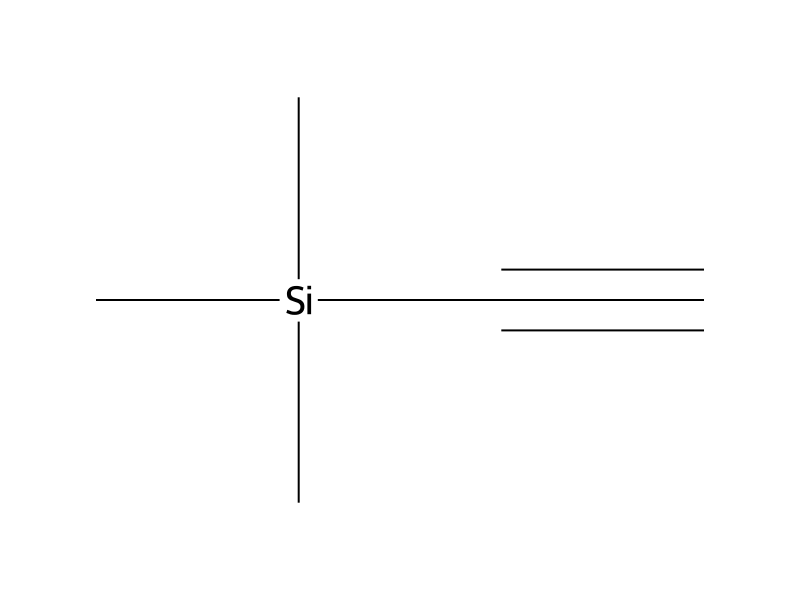
Br[C:2]1[N:3]=[C:4]([CH3:7])[S:5][CH:6]=1.C(N(CC)CC)C.[C:15]([Si:17]([CH3:20])([CH3:19])[CH3:18])#[CH:16].O>C(OCC)(=O)C.[Cu]I.Cl[Pd](Cl)([P](C1C=CC=CC=1)(C1C=CC=CC=1)C1C=CC=CC=1)[P](C1C=CC=CC=1)(C1C=CC=CC=1)C1C=CC=CC=1>[CH3:7][C:4]1[S:5][CH:6]=[C:2]([C:16]#[C:15][Si:17]([CH3:20])([CH3:19])[CH3:18])[N:3]=1A flask was charged with 4-bromo-2-methylthiazole (400 mg, 2.247 mmol) and triethylamine (8 mL) and sparged with nitrogen for 15 min. To this was added ethynyltrimethylsilane (0.381 mL, 2.70 mmol) and purged 15 min longer. To this was added copper(I) iodide (21.39 mg, 0.112 mmol), and Pd(PPh3)2Cl2 (79 mg, 0.112 mmol). The reaction stirred at room temperature for 72 h. The reaction was diluted with ethyl acetate (16 mL) and poured into water. The black heterogeneous emulsion was filtered through a plug of celite and the layers separated. The organics were washed with brine, dried over magnesium sulfate, and concentrated. Column chromatography (5%-->6% EtOAc/Hex) gave 307 mg (70%) as a light amber oil. 1H-NMR (CDCl3, 500 MHz) δ 7.34 (s, 1H), 2.72 (s, 3H), 0.27 (s, 9H). 13C-NMR (CDCl3, 126 MHz) δ 165.6, 137.0, 123.0, 98.4, 94.6, 19.3, −0.1.