Diisopropylethylamine → 4-chloro-2,5-difluoro-N-[(1S)-2,2,2-trifluoro-1-methylethyl]benzamide
Reaktionsgleichung

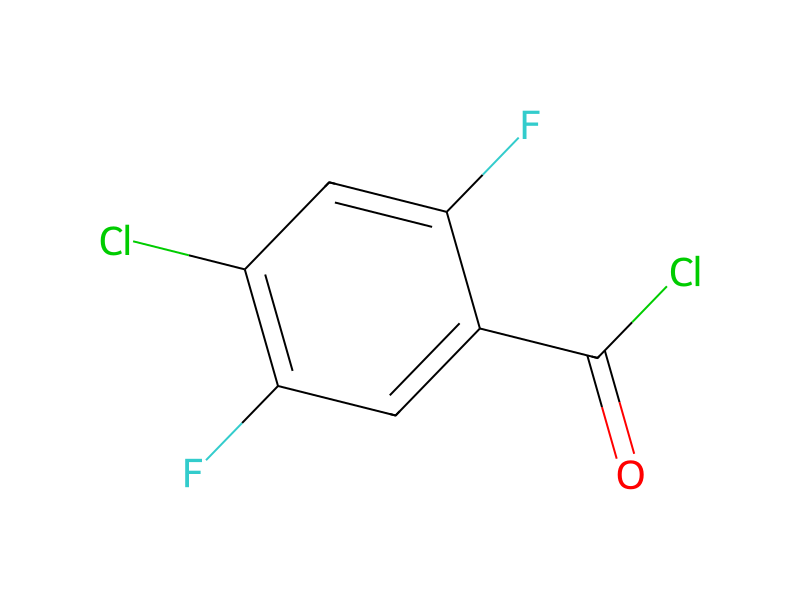
[Cl:1][C:2]1[C:10]([F:11])=[CH:9][C:5]([C:6](Cl)=[O:7])=[C:4]([F:12])[CH:3]=1.Cl.[F:14][C:15]([F:20])([F:19])[C@@H:16]([NH2:18])[CH3:17].C(N(C(C)C)CC)(C)C.C([O-])(O)=O.[Na+]>>[Cl:1][C:2]1[C:10]([F:11])=[CH:9][C:5]([C:6]([NH:18][C@@H:16]([CH3:17])[C:15]([F:20])([F:19])[F:14])=[O:7])=[C:4]([F:12])[CH:3]=1Komponenten
5




Versuchsvorschrift
4-Chloro-2,5-difluorobenzoyl chloride (29.6 mg, 0.140 mmol) (Oakwood, Cat. #: 001628) was added to a mixture of (2S)-1,1,1-trifluoropropan-2-amine hydrochloride (20.0 mg, 0.134 mmol) (SynQuest Lab, Cat. #: 3130-7-S1) and diisopropylethylamine (58 μL, 0.33 mmol) in dichloromethylene (4.0 mL) at 0° C. The reaction mixture was stirred at room temperature for 30 min., worked up with saturated aqueous NaHCO3, and extracted with dichloromethylene (3×10 mL). The combined organic layers were washed with brine, dried over MgSO4, filtered and concentrated under reduced pressure to afford the desired product which was directly used in the next step reaction without further purification. LCMS (M+H)+: m/z=288.0/290.0.
Aufarbeitung
- extractionextracted with dichloromethylene (3×10 mL)
- washThe combined organic layers were washed with brine
- dry with materialdried over MgSO4
- filtrationfiltered
- concentrationconcentrated under reduced pressure
Quellen und Nachweise
- ORD-Eintrag
- ord-2da1df5965224424b7a414f8c308c3c1
- Quelldatensatz
- uspto-grants-2014_04
- Patentnummer
- US08691807B2
Notizen zur Reaktion
Wird geladen…