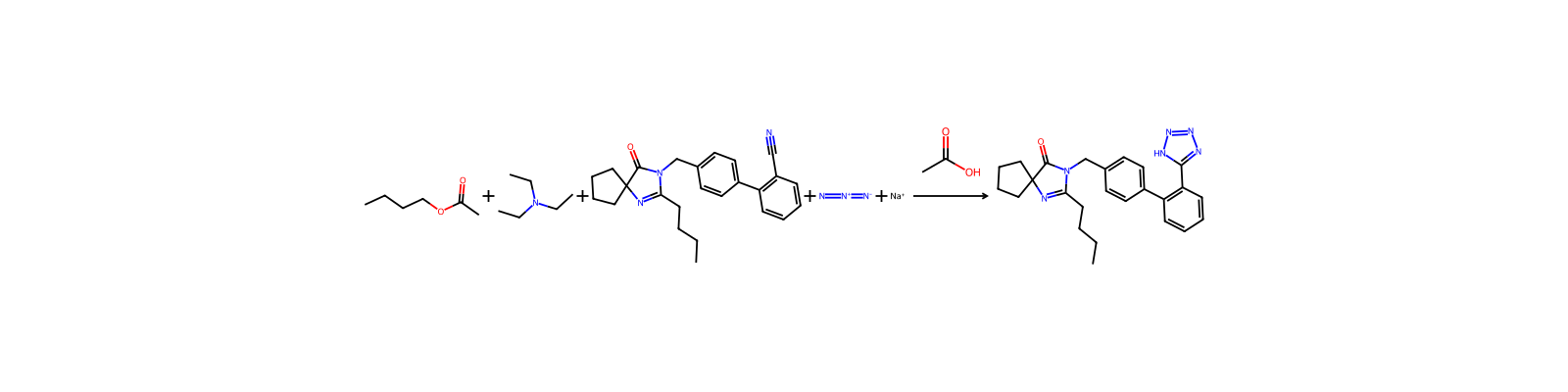
C(OCCCC)(=O)C.C(N(CC)CC)C.[CH2:16]([C:20]1[N:24]([CH2:25][C:26]2[CH:31]=[CH:30][C:29]([C:32]3[CH:37]=[CH:36][CH:35]=[CH:34][C:33]=3[C:38]#[N:39])=[CH:28][CH:27]=2)[C:23](=[O:40])[C:22]2([CH2:44][CH2:43][CH2:42][CH2:41]2)[N:21]=1)[CH2:17][CH2:18][CH3:19].[N-:45]=[N+:46]=[N-:47].[Na+]>C(O)(=O)C>[CH2:16]([C:20]1[N:24]([CH2:25][C:26]2[CH:31]=[CH:30][C:29]([C:32]3[CH:37]=[CH:36][CH:35]=[CH:34][C:33]=3[C:38]3[NH:47][N:46]=[N:45][N:39]=3)=[CH:28][CH:27]=2)[C:23](=[O:40])[C:22]2([CH2:41][CH2:42][CH2:43][CH2:44]2)[N:21]=1)[CH2:17][CH2:18][CH3:19]A RB flask was charged with n-butyl Acetate (50 ml), triethyl amine (22 ml) and acetic acid (9 ml) and stirred. 2-(n-butyl)-3-[[2′-(cyano)biphenyl-4-yl]methyl]-1,3-diazaspiro[4.4]non-1-en-4-one (10 g) and sodium Azide (3.4 g) was added to the flask and the reaction mixture was heated at 115-120° C. for 24 hrs, followed by cooling. The reaction was then quenched by addition of water (30 ml). The pH of the aqueous layer was adjusted between 10 to 11 with 30% Sodium hydroxide and then stirred for 10 min. Layers were separated and oily layer was treated with water and xylene. The pH of the aqueous layer was adjusted between 2 and 3 by the addition of hydrochloric acid and then stirred for 1 hour, filtered to obtain solid material which was washed with water (20 ml) and ethyl Acetate (5 ml) and dried at 90-100° C.