Carbon tetrabromide → 4-(Bromomethyl)-1-(4-fluorophenyl)pyrrolidin-2-one
Reaktionsgleichung
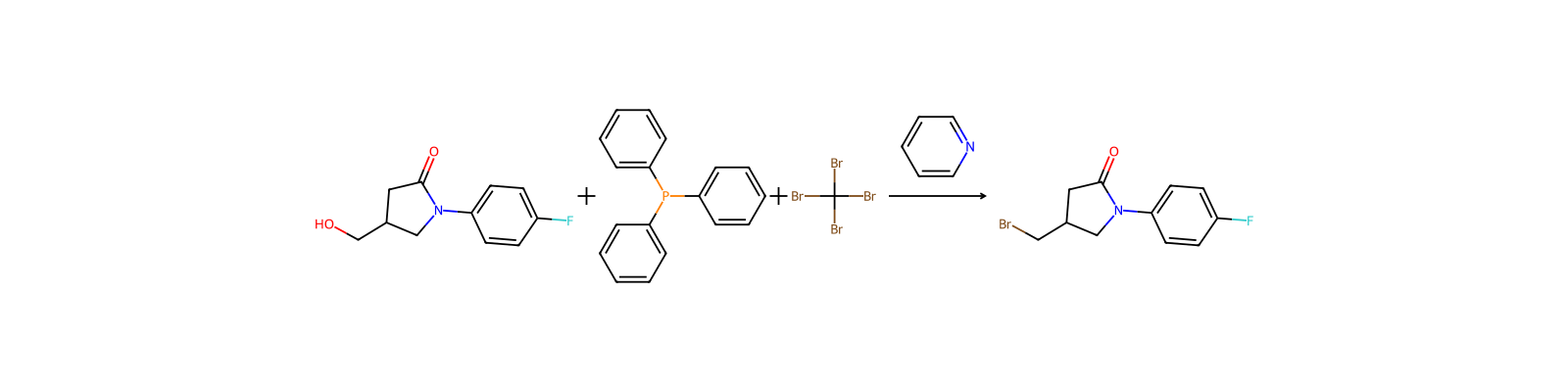
[F:1][C:2]1[CH:7]=[CH:6][C:5]([N:8]2[CH2:12][CH:11]([CH2:13]O)[CH2:10][C:9]2=[O:15])=[CH:4][CH:3]=1.C1(P(C2C=CC=CC=2)C2C=CC=CC=2)C=CC=CC=1.C(Br)(Br)(Br)[Br:36]>N1C=CC=CC=1>[Br:36][CH2:13][CH:11]1[CH2:12][N:8]([C:5]2[CH:6]=[CH:7][C:2]([F:1])=[CH:3][CH:4]=2)[C:9](=[O:15])[CH2:10]1Komponenten
5
Edukt 3



Produkt 1

Reagenzien, Katalysatoren, Lösungsmittel 1

Versuchsvorschrift
To a cooled solution of 1-(4-fluorophenyl)-4-(hydroxymethyl)pyrrolidin-2-one (0.05 g, 0.25 mmol) in pyridine (3 ml) was added triphenylphosphine (0.130 g, 0.5 mmol). The solution was stirred and carbon tetrabromide (0.08 g, 0.25 mmol) was added in 3 separate portions. The reaction mixture was then allowed to warm to room temperature and stirred for three hours. The reaction was quenched with methanol and the solvent removed. The residue was dissolved in EtOAc (75 ml) and sequentially washed with ammonium chloride (sat, 2×25 ml) and water (25 ml). The organic layer was concentrated and purified using preparative tlc (1:1 EtOac:Hexanes) to yield 4-(bromomethyl)-1-(4-fluorophenyl)pyrrolidin-2-one (HNMR).
Aufarbeitung
- customseparate portions
- stirringstirred for three hours
- customThe reaction was quenched with methanol
- customthe solvent removed
- dissolutionThe residue was dissolved in EtOAc (75 ml)
- washsequentially washed with ammonium chloride (sat, 2×25 ml) and water (25 ml)
- concentrationThe organic layer was concentrated
- custompurified
Quellen und Nachweise
- ORD-Eintrag
- ord-93f60da592cc408aa40bfb6a22ddf852
- Quelldatensatz
- uspto-grants-2008_11
- Patentnummer
- US07452889B2
Notizen zur Reaktion
Wird geladen…