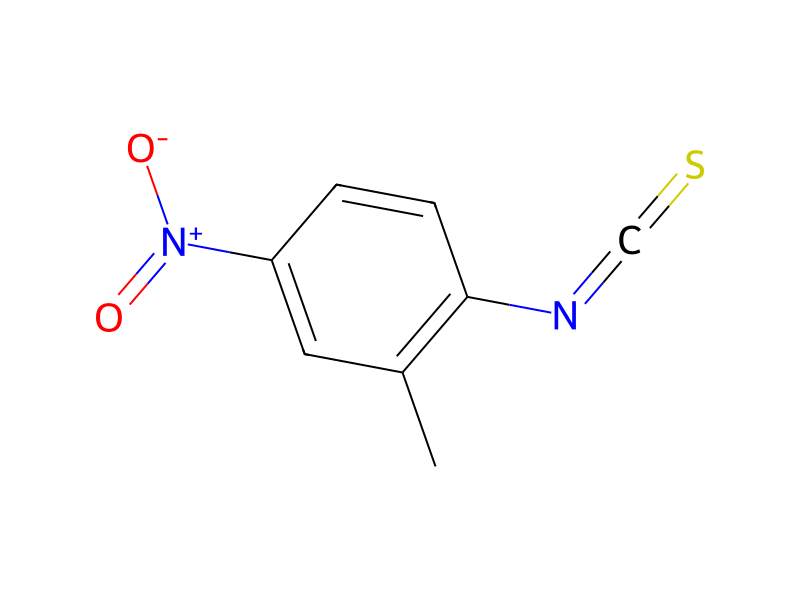
C(O[C:4](=[O:11])[CH2:5][NH:6][CH2:7][CH:8]([CH3:10])[CH3:9])C.CCN(CC)CC.[CH3:19][C:20]1[CH:25]=[C:24]([N+:26]([O-:28])=[O:27])[CH:23]=[CH:22][C:21]=1[N:29]=[C:30]=[S:31]>O.CC(C)=O>[CH3:19][C:20]1[CH:25]=[C:24]([N+:26]([O-:28])=[O:27])[CH:23]=[CH:22][C:21]=1[N:29]=[C:30]1[N:6]([CH2:7][CH:8]([CH3:9])[CH3:10])[CH2:5][C:4](=[O:11])[S:31]1A solution of N-isobutylglycine ethyl ester (0.41 g, 2.57 mmol) in water (5 mL) was treated with Et3N (0.71 mL, 5.15 mmol), followed by a solution of 2-methyl-4-nitrophenyl isothiocyanate (0.50 g, 2.57 mmol) in acetone (5 mL). The resulting mixture waxs heated at 40° C. for 2 h, then cooled to room temperature and concentrated under reduced pressure. The residue was separated between water (25 mL) and ethyl acetate (25 mL). The organic phase was dried (MgSO4) and concentrated under reduced pressure to afford 2-(2-methyl-4-nitrophenylimino)-3-isobutyl-1,3-thiazolidin-5-one (0.16 g, 88%): mp 152° C.