StartseiteMCPWorkbenchSkills
StartseiteWorkbenchBenachrichtigungenMein Bereich
llms.txt · MCP-AnleitungDatenschutz · Nutzungsbedingungen · Supportv1.8.0
  1. Startseite
  2. /Reaktion

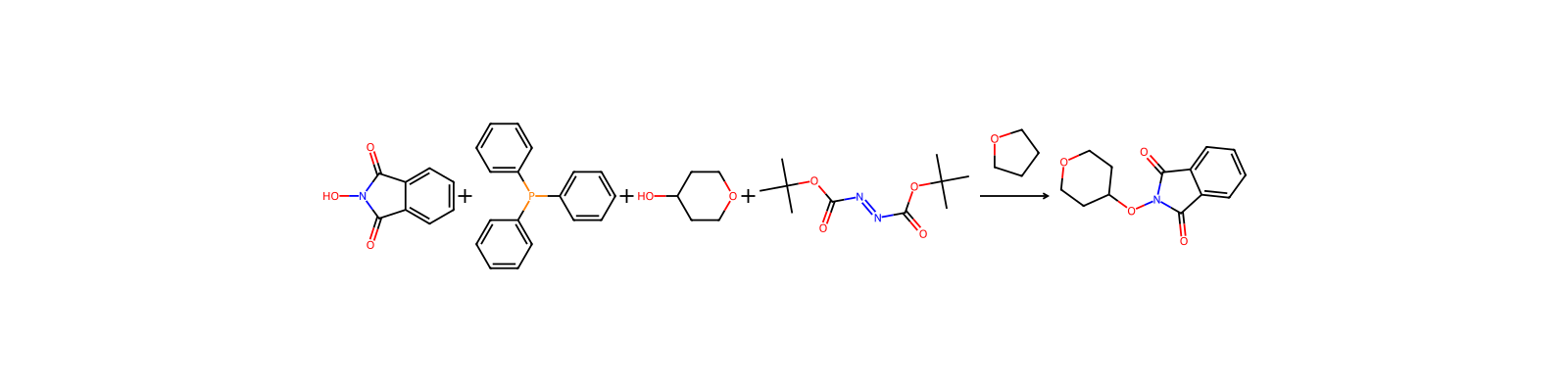
N-Hydroxyphthalimide → 2-(tetrahydro-2H-pyran-4-yloxy)-1H-isoindole-1,3(2H)-dione

HRID 29162
Notizen
Druckvorschau

Reaktionsgleichung

Reaktionsgleichung von HRID 29162
[OH:1][N:2]1[C:6](=[O:7])[C:5]2=[CH:8][CH:9]=[CH:10][CH:11]=[C:4]2[C:3]1=[O:12].C1(P(C2C=CC=CC=2)C2C=CC=CC=2)C=CC=CC=1.[O:32]1[CH2:37][CH2:36][CH:35](O)[CH2:34][CH2:33]1.N(C(OC(C)(C)C)=O)=NC(OC(C)(C)C)=O>C1COCC1>[O:32]1[CH2:37][CH2:36][CH:35]([O:1][N:2]2[C:3](=[O:12])[C:4]3[C:5](=[CH:8][CH:9]=[CH:10][CH:11]=3)[C:6]2=[O:7])[CH2:34][CH2:33]1
KomponentenVersuchsvorschriftAufarbeitungQuellen und NachweiseNotizen zur Reaktion

Komponenten

6

Edukt 4

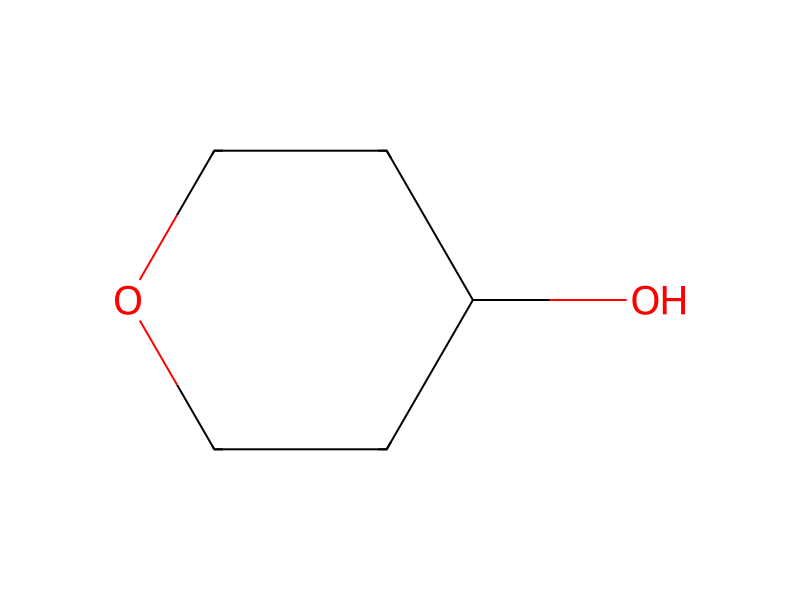
HCID 10665N-HydroxyphthalimideHCID 11776TriphenylphosphineHCID 74956Tetrahydro-4H-pyran-4-olHCID 97268Di-tert-butyl azodicarboxylate

Produkt 1

HCID 229971882-(tetrahydro-2H-pyran-4-yloxy)-1H-isoindole-1,3(2H)-dione

Reagenzien, Katalysatoren, Lösungsmittel 1

HCID 8028
Tetrahydrofuran
Lösungsmittel

Versuchsvorschrift

A light suspension containing N-hydroxylphthalimide (18.4 mmol, 3.0 g), triphenylphosphine (18.4 mmol, 4.82 g), tetrahydro-4H-pyran-4-ol (18.4 mmol, 1.75 mL) and anhydrous THF (50 mL), were transferred to a flask containing di-tert-butyl azodicarboxylate (20.2 mmol, 4.66 g) under nitrogen. Over 2 hours the reaction stirred at room temperature and changed from a dark orange to yellow in appearance. The solvent was removed under vacuum and replaced with trifluoroacetic acetic acid (10 mL). The reaction was stirred for 30 minutes and the TFA was removed under vacuum. The crude residue was then dissolved in ethyl acetate, washed with a saturated aqueous solution of sodium bicarbonate, 5% aqueous solution of potassium carbonate, brine and dried over magnesium sulfate. The solvent was removed under vacuum and the residual triphenylphosphine oxide was crystallized and filtered using hexanes and ether. The solvent was again removed and the crude solid was purified by silica gel chromatography (2:1 hexanes/ethyl acetate) and recrystallization using methylene chloride and hexanes providing 1.69 g (37%) of a white crystal. Rf=0.3 (2:1 hexanes/ethyl acetate); H1-NMR (CDCl3): δ 7.84-7.82 (2H,m), 7.75-7.73(2H,m), 4.46-4.40 (1H,m), 4.08-4.02 (2H,m), 3.50-3.44 (2H,m), 2.04-1.98 (2H,m), 1.92-1.84 (2H,m).

Aufarbeitung

  1. customwere transferred to a flask
  2. customThe solvent was removed under vacuum
  3. stirringThe reaction was stirred for 30 minutes
  4. customthe TFA was removed under vacuum
  5. dissolutionThe crude residue was then dissolved in ethyl acetate
  6. washwashed with a saturated aqueous solution of sodium bicarbonate, 5% aqueous solution of potassium carbonate, brine
  7. dry with materialdried over magnesium sulfate
  8. customThe solvent was removed under vacuum
  9. customthe residual triphenylphosphine oxide was crystallized
  10. filtrationfiltered
  11. customThe solvent was again removed
  12. customthe crude solid was purified by silica gel chromatography (2:1 hexanes/ethyl acetate) and recrystallization

Quellen und Nachweise

ORD-Eintrag
ord-fce6c1405a3f40fe8d7a6b21743c7f28
Quelldatensatz
uspto-grants-2008_09
DOI
10.6084/m9.figshare.5104873.v1
Patentnummer
US07419967B2

Notizen zur Reaktion

Wird geladen…

Auf dieser SeiteKomponentenVersuchsvorschriftAufarbeitungQuellen und NachweiseNotizen zur Reaktion