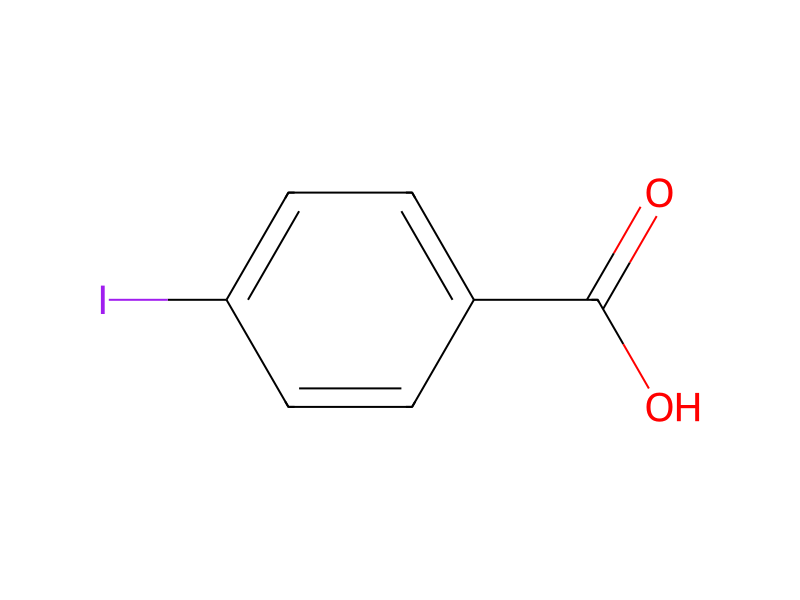
[I:1][C:2]1[CH:10]=[CH:9][C:5]([C:6]([OH:8])=O)=[CH:4][CH:3]=1.C(O[C:16]([CH3:19])([CH3:18])[CH3:17])(=O)NN.C[N:21](C(ON1N=NC2C=CC=NC1=2)=[N+](C)C)C.F[P-](F)(F)(F)(F)F.ON1C2C=CC=CC=2N=N1.C(N(CC)C(C)C)(C)C.C[N:64](C)[CH:65]=[O:66]>>[CH3:17][C:16]([CH3:19])([CH3:18])[C:65]([NH:64][NH:21][C:6](=[O:8])[C:5]1[CH:4]=[CH:3][C:2]([I:1])=[CH:10][CH:9]=1)=[O:66]4-Iodobenzoic acid (5 g, 20.2 mmol) was dissolved in dimethylformamide (50 ml). To this was added tert-butyl carbazate (2.66 g, 20.2 mmol), HATU (9.2 g, 24.2 mmol), 1-hydroxybenzotriazole (2.7 g, 20.2 mmol) and N,N-diisopropylethylamine (10.5 ml, 60.5 mmol). The mixture was stirred for 17 hours at room temperature. The solvent was removed in vacuo and the residue partitioned between dichloromethane (75 ml) and saturated aqueous sodium bicarbonate solution (75 ml). The organic layer was washed with water (100 ml), brine (100 ml), dried over magnesium sulfate, filtered and the solvent removed in vacuo. The desired product was obtained as a cream solid (4.6 g, 12.7 mmol).
Wird geladen…