Methanesulfonyl chloride → N-Cyclopropyl-6-methyl-4'-(5-{[(methylsulfonyl)amino]methyl}-1,3,4-oxadiazol-2-yl)-1,1'-biphenyl-3-carboxamide
Reaktionsgleichung
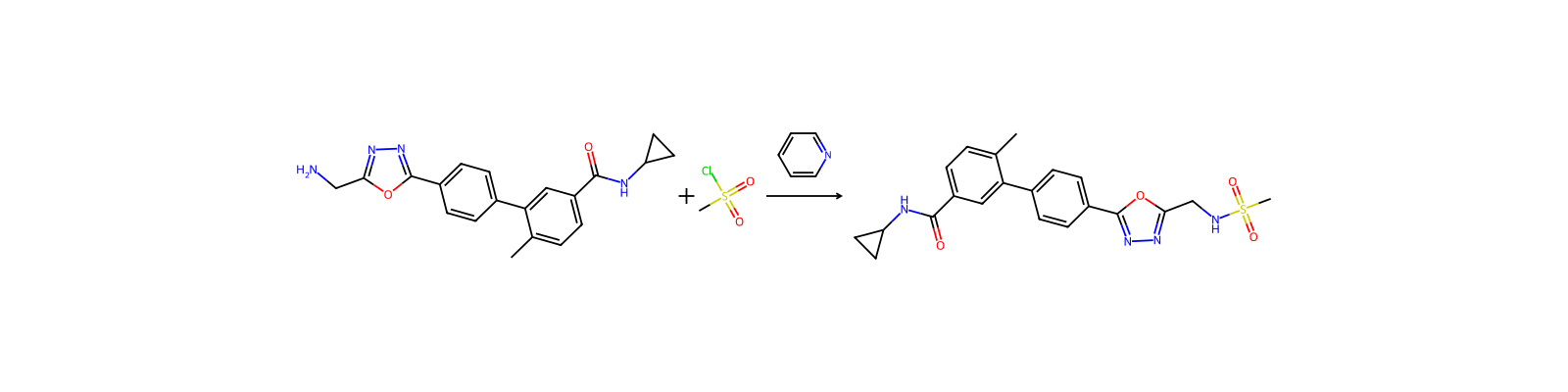
[NH2:1][CH2:2][C:3]1[O:7][C:6]([C:8]2[CH:13]=[CH:12][C:11]([C:14]3[C:19]([CH3:20])=[CH:18][CH:17]=[C:16]([C:21]([NH:23][CH:24]4[CH2:26][CH2:25]4)=[O:22])[CH:15]=3)=[CH:10][CH:9]=2)=[N:5][N:4]=1.[CH3:27][S:28](Cl)(=[O:30])=[O:29]>N1C=CC=CC=1>[CH:24]1([NH:23][C:21]([C:16]2[CH:15]=[C:14]([C:11]3[CH:10]=[CH:9][C:8]([C:6]4[O:7][C:3]([CH2:2][NH:1][S:28]([CH3:27])(=[O:30])=[O:29])=[N:4][N:5]=4)=[CH:13][CH:12]=3)[C:19]([CH3:20])=[CH:18][CH:17]=2)=[O:22])[CH2:26][CH2:25]1Komponenten
4
Edukt 2


Produkt 1

Reagenzien, Katalysatoren, Lösungsmittel 1

Versuchsvorschrift
4′-[5-Aminomethyl)-1,3,4-oxadiazol-2-yl]-N-cyclopropyl-6-methyl-1,1′-biphenyl-3-carboxamide (Example 53) (30 mg) was mixed with methanesulphonyl chloride (0.02 ml) and pyridine (0.034 ml) in DCm (3 ml) and the reaction stirred at room temperature for 18 hours. The reaction was washed with water (4×4 ml) and then hydrochloric acid (2N, 5 ml). The organic phase was reduced to dryness under vacuum and the residue purified by HPLC to give after evaporation of the solvents N-cyclopropyl-6-methyl-4′-5-{[(methylsulfonyl)amino]methyl}-1,3,4-oxadiazol-2-yl)-1,1′-biphenyl-3-carboxamide.