Reaktionsgleichung

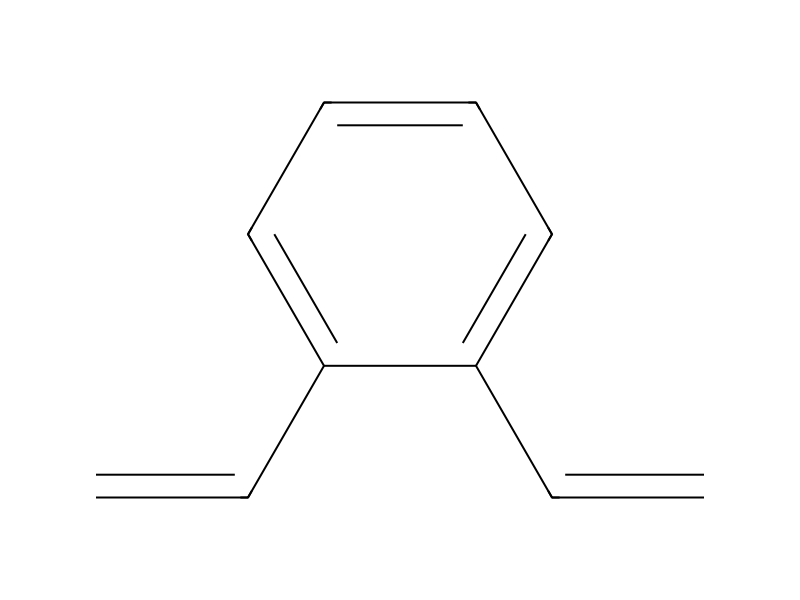
B(F)(F)F.CCO[CH2:8][CH3:9].C(=O)C1OC=CC=1.[CH:17]([C:19]1[CH:24]=[CH:23][CH:22]=[CH:21][C:20]=1[CH:25]=[CH2:26])=[CH2:18].C1(=O)C=CC(=O)C=C1>>[CH:17]([C:19]1[CH:24]=[CH:23][CH:22]=[CH:21][C:20]=1[CH:25]=[CH2:26])=[CH2:18].[C:8]1([CH3:9])[CH2:23][CH2:24][CH:19]([C:20]([CH3:25])=[CH2:21])[CH2:17][CH:18]=1Komponenten




Versuchsvorschrift
Many other additives were examined in the BF3.OEt2-catalyzed polymerization reactions of the Norway fish oil (Table 16). The copolymerization of furfural, divinylbenzene, and the Norway fish oil produced very hard, dark-colored thermosets in excellent overall mass recoveries (entries 2-4). Interestingly, p-benzoquinone and divinylbenzene polymerized with the Norway fish oil violently at room temperature to produce dark-colored polymeric materials (entries 7-10). The most interesting material was produced when 20% divinylbenzene and 10% p-mentha-1,8-diene were polymerized with the Norway fish oil using 5 weight percent BF3.OEt2 (entry 11). This reaction produced a very hard, shiny, dark-brown thermoset after being heated at 60° C. for one day and then 110° C. for 2 days. Furan and divinylbenzene were copolymerized with the Norway fish oil to produce very firm, dark-colored thermosets that were resistant to applied pressure (entries 13, 14).
Aufarbeitung
- customthe Norway fish oil produced very hard
- customto produce dark-colored polymeric materials (entries 7-10)
Quellen und Nachweise
- ORD-Eintrag
- ord-015cf34a37f44d7e90dbfdc001f8c3ce
- Quelldatensatz
- uspto-grants-2001_04
- Patentnummer
- US06211315B1
Verknüpfte Notizen
Wird geladen…