StartseiteMCPWorkbenchSkills
StartseiteWorkbenchBenachrichtigungenMein Bereich
llms.txt · MCP-AnleitungDatenschutz · Nutzungsbedingungen · Supportv1.8.0
  1. Startseite
  2. /Reaktion

Triphenylphosphine → Ethyl 5',6'-dihydro-5',5'-dimethyl-8'-(4-methylphenyl)-[2,2'-binaphthalene]-6-carboxylate

HRID 324245
Notizen
Druckvorschau

Reaktionsgleichung

Reaktionsgleichung von HRID 324245
[CH3:1][C:2]1[CH:7]=[CH:6][C:5]([C:8]2[C:17]3[C:12](=[CH:13][CH:14]=[C:15](Br)[CH:16]=3)[C:11]([CH3:20])([CH3:19])[CH2:10][CH:9]=2)=[CH:4][CH:3]=1.[Mg].Br[C:23]1[CH:24]=[C:25]2[C:30](=[CH:31][CH:32]=1)[CH:29]=[C:28]([C:33]([O:35][CH2:36][CH3:37])=[O:34])[CH:27]=[CH:26]2.C1C=CC(P(C2C=CC=CC=2)C2C=CC=CC=2)=CC=1.[H-].C([Al+]CC(C)C)C(C)C>C(Br)CBr.C1COCC1.[Cl-].[Zn+2].[Cl-].C1C=CC([P]([Ni]([P](C2C=CC=CC=2)(C2C=CC=CC=2)C2C=CC=CC=2)([P](C2C=CC=CC=2)(C2C=CC=CC=2)C2C=CC=CC=2)[P](C2C=CC=CC=2)(C2C=CC=CC=2)C2C=CC=CC=2)(C2C=CC=CC=2)C2C=CC=CC=2)=CC=1.Cl[Ni](Cl)([P](C1C=CC=CC=1)(C1C=CC=CC=1)C1C=CC=CC=1)[P](C1C=CC=CC=1)(C1C=CC=CC=1)C1C=CC=CC=1>[CH3:19][C:11]1([CH3:20])[CH2:10][CH:9]=[C:8]([C:5]2[CH:4]=[CH:3][C:2]([CH3:1])=[CH:7][CH:6]=2)[C:17]2[CH:16]=[C:15]([C:23]3[CH:32]=[CH:31][C:30]4[C:25](=[CH:26][CH:27]=[C:28]([C:33]([O:35][CH2:36][CH3:37])=[O:34])[CH:29]=4)[CH:24]=3)[CH:14]=[CH:13][C:12]1=2
KomponentenVersuchsvorschriftAufarbeitungQuellen und NachweiseNotizen zur Reaktion

Komponenten

11

Edukt 5

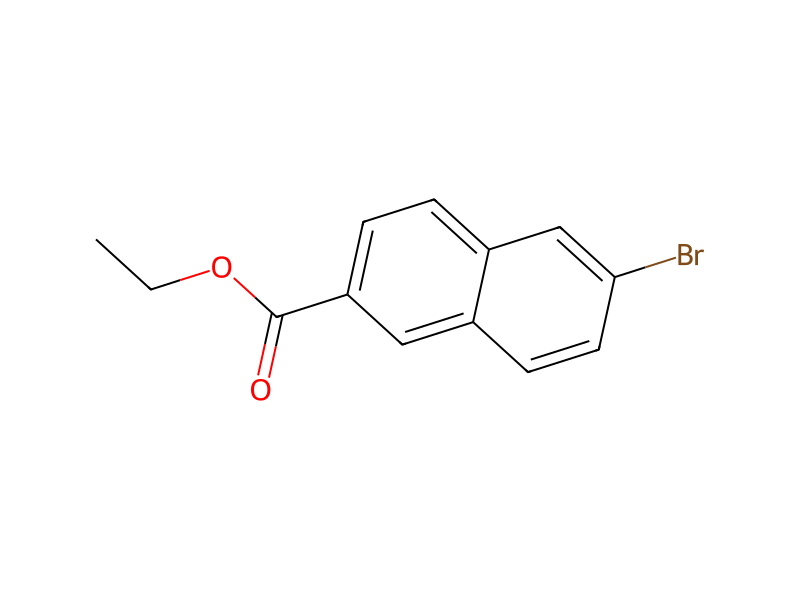
HCID 11776TriphenylphosphineHCID 1249959Ethyl 6-bromonaphthalene-2-carboxylate2×HCID 5462224MagnesiumHCID 106876226-Bromo-1,1-dimethyl-4-p-tolyl-1,2-dihydronaphthaleneHCID 21225700Diisobutylaluminumhydride

Produkt 1

HCID 15870725
Ethyl 5',6'-dihydro-5',5'-dimethyl-8'-(4-methylphenyl)-[2,2'-binaphthalene]-6-carboxylate

Reagenzien, Katalysatoren, Lösungsmittel 5

HCID 78391,2-DibromoethaneKatalysatorHCID 3007855ZincchlorideKatalysatorHCID 178418751HCID 178418751, VerbindungKatalysatorHCID 178420538HCID 178420538, VerbindungKatalysator2×HCID 8028TetrahydrofuranLösungsmittel6×

Versuchsvorschrift

A solution of 3,4-dihydro-1-(4-methylphenyl)-4,4-dimethyl-7-bromonaphthalene Compound D) 0.45 g, 1.40 mmol) and THF (2.1 ml) was added to magnesium turnings (0.044 g, 1.82 mmol) at room temperature under argon. Two drops of ethylene dibromide were added, and the solution, which slowly became cloudy and yellow, was heated to reflux for 1.5 hours. In a second flask was added zinc chloride (0.210 g, 1.54 mmol), which was melted under high vacuum, cooled to room temperature and dissolved in THF (3 ml). The Grignard reagent was added to the second flask and, after 30 minutes at room temperature, a solution of ethyl 6-bromo-2-naphthalinecarboxylate (Compound N) 0.293 g, (1.05 mmol) and THF (2 ml) were added. In a third flask was prepared a solution of Ni(PPh3)4 and THF as follows: To a solution of NiCl2(PPh3)2 (0.82 g, 1.25 mmol) and PPh3 (0.66 g, 2.5 mmol) in THF (3.5 ml) was added a 1M solution of diisobutylaluminum hydride and hexanes (2.5 ml, 2.5 mmol), and the resulting solution diluted with THF to a total volume of 15 ml and stirred at room temperature for 15 minutes. Three 0.60 ml aliquots of the Ni(PPh3)4 solution were added at 15 minutes intervals to the second flask. The resulting suspension was stirred at room temperature for 2 hours. The reaction was quenched by the addition of 5 ml 1N aqueous HCl and stirred for 1 hour before extracting the products with ethyl acetate. The organic layers were combined, washed with brine, dried (MgSO4), filtered and the solvent removed in-vacuo. The residue was crystalized from hexanes to give 130 mg of pure material. The mother liquor was concentrated under reduced pressure and the residue purified by silica gel chromatography (95:5-hexanes:ethyl acetate) to give an additional 170 mg of the title compound (overall yield=300 mg, 64%) as a colorless solid. 1H NMR (CDCl3) δ 8.57 (s, 1H), 8.05 (dd, 1H, J=1.7, 8.0 Hz), 7.84-7.95 (overlapping d's, 3H), 7.66 (dd, 1H, J=1.7, 8.5 Hz), 7.58 (dd, 1H, J=2.0, 8.0 Hz), 7.48 (d, 1H, J=8.0 Hz), 7.43 (d, 1H, J=2.0 Hz), 7.32 (d, 2H, J=8.0 Hz), 7.21 (d, 2H, J=8.0 Hz), 6.04 (t, 1H, J=4.8 Hz), 4.44 (q, 2H, J=7.1 Hz), 2.40 (s, 3H), 2.39 (d, 2H, J=4.8 Hz), 1.45 (t, 3H, J=7.1 Hz), 1.39 (s, 6H).


Aufarbeitung

  1. temperaturethe solution, which slowly became cloudy and yellow, was heated
  2. temperatureto reflux for 1.5 hours
  3. stirringThe resulting suspension was stirred at room temperature for 2 hours
  4. customThe reaction was quenched by the addition of 5 ml 1N aqueous HCl
  5. stirringstirred for 1 hour
  6. extractionbefore extracting the products with ethyl acetate
  7. washwashed with brine
  8. dry with materialdried (MgSO4)
  9. filtrationfiltered
  10. customthe solvent removed in-vacuo
  11. customThe residue was crystalized from hexanes

Quellen und Nachweise

ORD-Eintrag
ord-ac44185bf9ef404ea567af950e270be1
Quelldatensatz
uspto-grants-2001_04
DOI
10.6084/m9.figshare.5104873.v1
Patentnummer
US06218128B1

Notizen zur Reaktion

Wird geladen…

Auf dieser SeiteKomponentenVersuchsvorschriftAufarbeitungQuellen und NachweiseNotizen zur Reaktion