Reaktionsgleichung
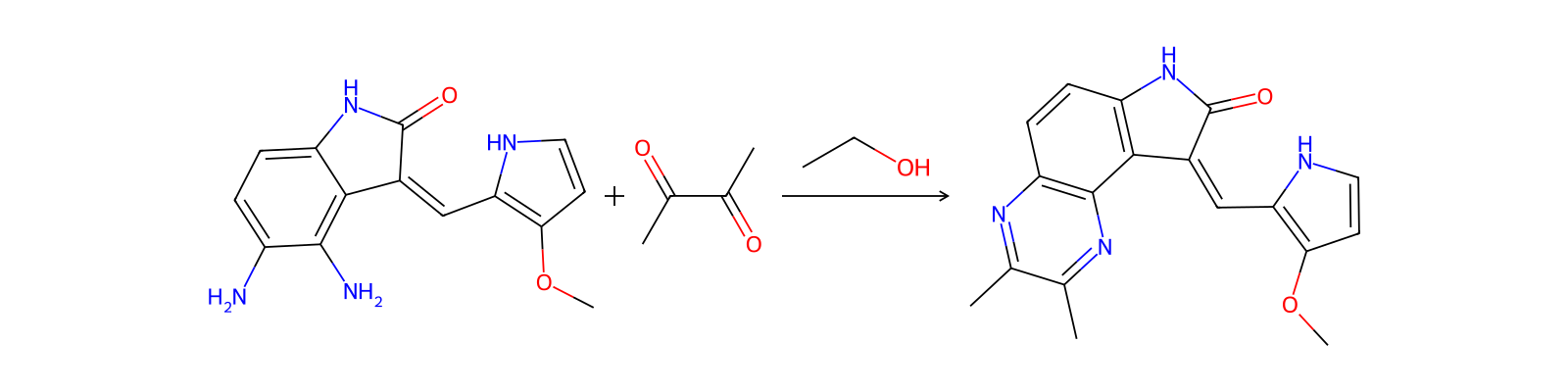
[NH2:1][C:2]1[C:10]([NH2:11])=[CH:9][CH:8]=[C:7]2[C:3]=1/[C:4](=[CH:13]/[C:14]1[NH:15][CH:16]=[CH:17][C:18]=1[O:19][CH3:20])/[C:5](=[O:12])[NH:6]2.[CH3:21][C:22](=O)[C:23](=O)[CH3:24]>C(O)C>[CH3:21][C:22]1[C:23]([CH3:24])=[N:11][C:10]2[CH:9]=[CH:8][C:7]3[NH:6][C:5](=[O:12])/[C:4](=[CH:13]\[C:14]4[NH:15][CH:16]=[CH:17][C:18]=4[O:19][CH3:20])/[C:3]=3[C:2]=2[N:1]=1Komponenten
4
Edukt 2


Produkt 1

Reagenzien, Katalysatoren, Lösungsmittel 1

Versuchsvorschrift
Using Method A above, (Z)-4,5-diamino-1,3-dihydro-3-[(3-methoxy-1H-pyrrol-2-yl)methylene]-2H-indol-2-one (60 mg, 0.22 mmol) (Starting Material 5) was condensed with 2,3-butanedione (135 μL) (Aldrich) in ethanol (3 ml) at reflux to give (Z)-7,9-dihydro-2,3-dimethyl-9-[(3-methoxy-1H-pyrrol-2-yl)methylene]-8H-pyrrolo-[3,2-f]quinoxalin-8-one in 100% yield.
Aufarbeitung
- temperatureat reflux
Quellen und Nachweise
- ORD-Eintrag
- ord-fbc30e3964074ba392db3c98ca5b258c
- Quelldatensatz
- uspto-grants-2001_04
- Patentnummer
- US06221867B1
Verknüpfte Notizen
Wird geladen…