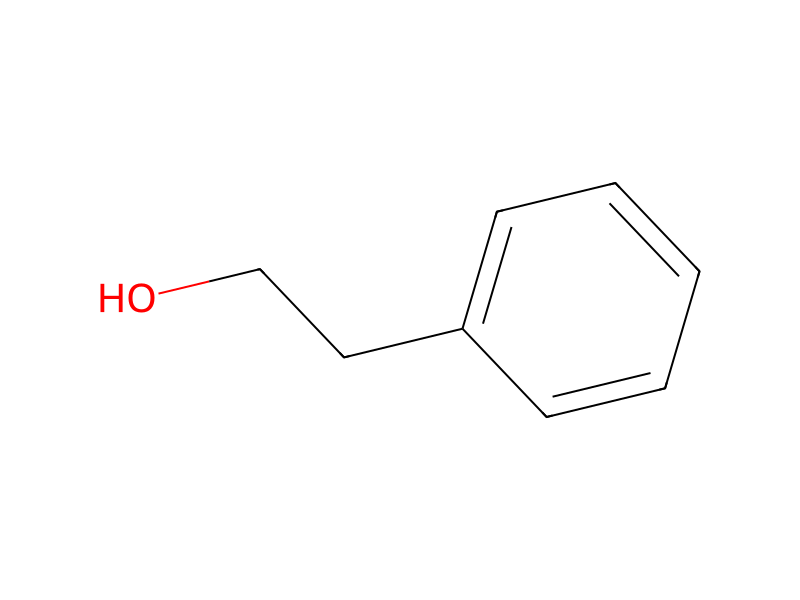
CCOC(/N=N/C(OCC)=O)=O.[OH:13][C:14]1[CH:22]=[CH:21][C:17]([CH2:18][C:19]#[N:20])=[CH:16][CH:15]=1.[CH2:23](O)[CH2:24][C:25]1[CH:30]=[CH:29][CH:28]=[CH:27][CH:26]=1.C1(P(C2C=CC=CC=2)C2C=CC=CC=2)C=CC=CC=1>C1COCC1>[C:25]1([CH2:24][CH2:23][O:13][C:14]2[CH:22]=[CH:21][C:17]([CH2:18][C:19]#[N:20])=[CH:16][CH:15]=2)[CH:30]=[CH:29][CH:28]=[CH:27][CH:26]=1Diethylazodicarboxylate (DEAD, 7.85 g, 45.1 mmol), was added to a solution of 4-hydroxybenzyl cyanide (5.0 g, 37.6 mmol), phenethylalcohol (5.04 g, 41.3 mmol), and triphenylphosphine (11.82 g, 45.1 mmol) in anhydrous THF (100 mL) at room temperature. A water bath was used to maintain the temperature of the exothermic reaction near ambient. The water bath was removed after 40 minutes and the yellow solution stirred 24 hours. Water was added and the mixture extracted with ether (3×100 mL). The combined organic layers were washed with water (2×75 mL), brine, dried over anhydrous magnesium sulfate and concentrated in vacuo to give an oily yellow solid. The residue was washed with ether, and the resulting white solid removed by filtration. The filtrate was concentrated in vacuo to give a yellow oil, which was purified by chromatography on silica gel with elution by EtOAc/hexanes (2:8) to give the desired product (5.87 g, 66%) as a light yellow oil.