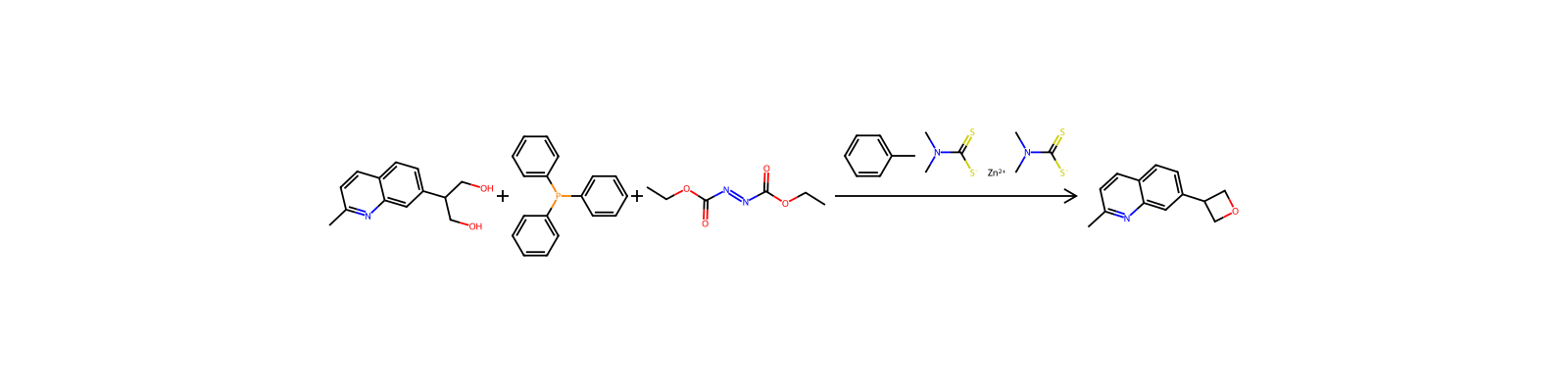
[CH3:1][C:2]1[CH:11]=[CH:10][C:9]2[C:4](=[CH:5][C:6]([CH:12]([CH2:15][OH:16])[CH2:13]O)=[CH:7][CH:8]=2)[N:3]=1.C1C=CC(P(C2C=CC=CC=2)C2C=CC=CC=2)=CC=1.CCOC(/N=N/C(OCC)=O)=O>C1(C)C=CC=CC=1.CN(C)C([S-])=S.[Zn+2].CN(C)C([S-])=S>[CH3:1][C:2]1[CH:11]=[CH:10][C:9]2[C:4](=[CH:5][C:6]([CH:12]3[CH2:13][O:16][CH2:15]3)=[CH:7][CH:8]=2)[N:3]=1To a solution of 2-(2-methylquinolin-7-yl)propane-1,3-diol (0.100 g, 0.46 mmol) and PPh3 (0.241 g, 0.921 mmol) in toluene (10 mL) was added zinc(II) dimethylcarbamodithioate (0.211 g, 0.690 mmol) and DEAD (0.145 ml, 0.921 mmol). The resulting mixture was stirred at ambient temperature for 30 hours. The solvent was removed under reduced pressure, and water (20 mL) and ethyl acetate (30 mL) were added. The organic layer was separated, washed with brine, dried (sodium sulfate), filtered and concentrated under reduced pressure. The residue obtained was purified by C-18 reverse phase flash chromatography (Biotage SP4 unit, C-18 25M column, 0-90% CH3CN/water gradient; 25 CV)) to give 2-methyl-7-(oxetan-3-yl)quinoline (0.020 g, 0.100 mmol, 22% yield) as a solid.