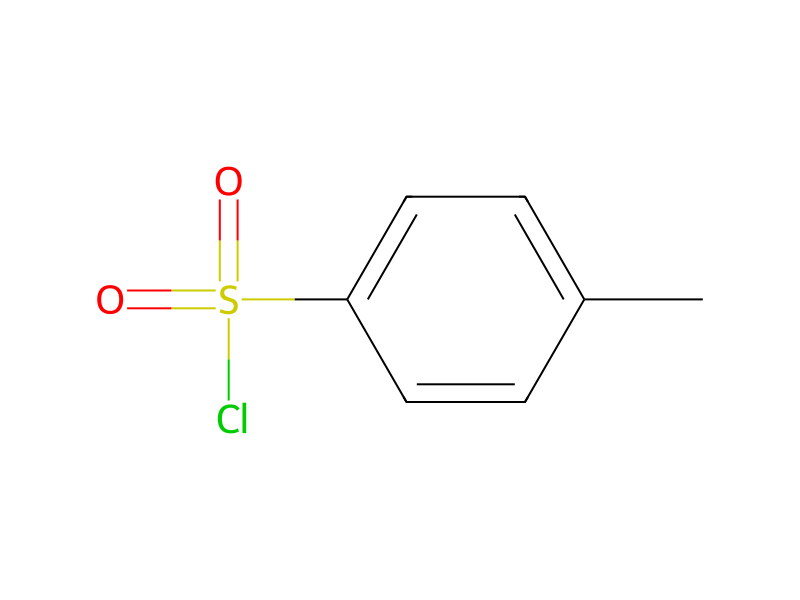
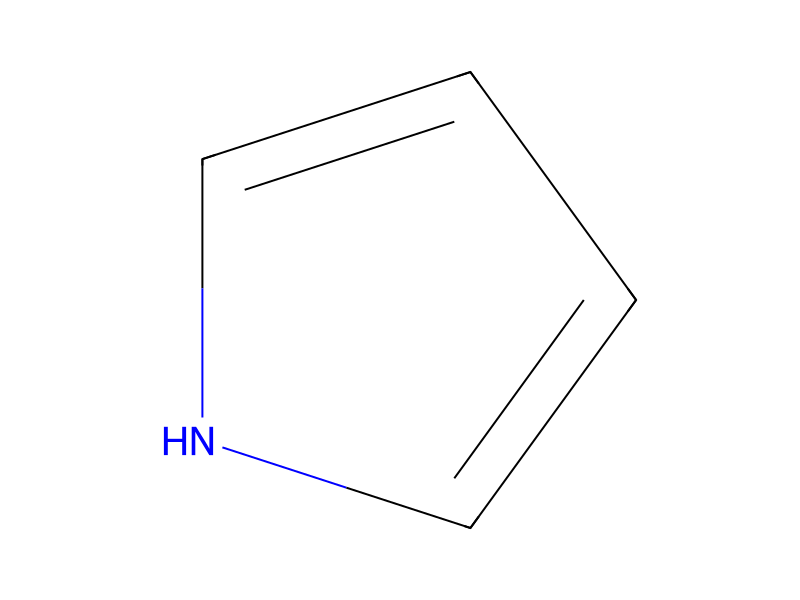
In a 1-liter three-neck flask, 8.65 cm3 of freshly distilled pyrrole (125 mmoles) was introduced together with 100 cm3 of THF and 1 cm3 of a 40% aqueous solution of tetrabutylammonium hydroxide. 125 cm3 of a 50% aqueous NaOH solution was added and the mixture was then vigorously stirred. After 5 minutes, a solution of 38 g of tosylchloride (200 mmoles) in 100 cm3 of THF was dropwise added. The obtained adduct was maintained under stirring until the temperature reached a maximum and then again during some 30 minutes more. After decantation, the aqueous layer was extracted with ethyl acetate, and the combine organic layer was concentrated under reduced pressure. The residue was dissolved in dichloromethane, washed with water, dried over magnesium sulfate and evaporated. 27 g of a white solid compound was obtained (1) (M=221, yield: 97.6%). Recrystallization in methanol. F (° C)=92. Elemental analysis: calc.: C 59.73; H 4.98; N 6.33; found: C 59.59; H 4.67; N 6.32. NMR: (CDCl3) ppm 7.7 d J(Hz) 8 2H; 7.2 4H; 6.25 2H; 2.33 s 3H.