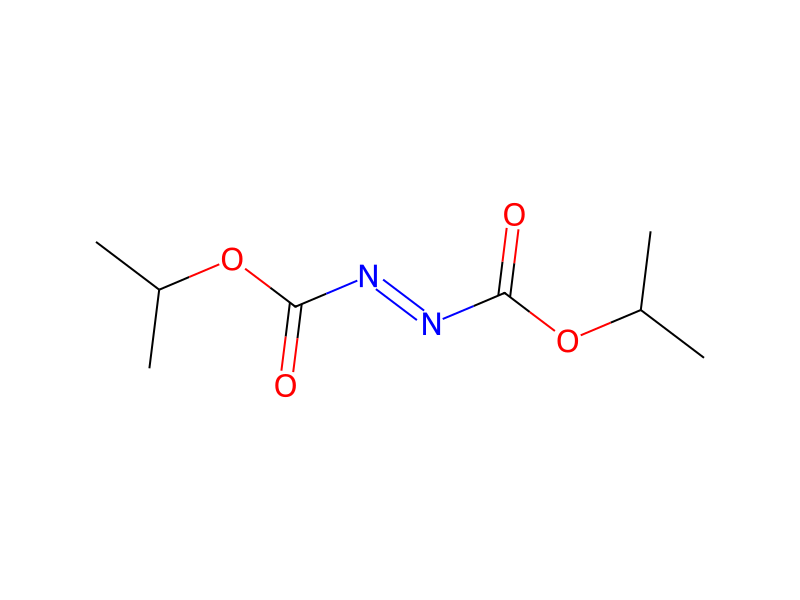
[C:1]([O:5][C:6]([N:8]1[CH2:12][C@H:11]([OH:13])[CH2:10][C@H:9]1[C:14]([O:16][CH3:17])=[O:15])=[O:7])([CH3:4])([CH3:3])[CH3:2].[C:18]1(O)[CH:23]=[CH:22][CH:21]=[CH:20][CH:19]=1.C1C=CC(P(C2C=CC=CC=2)C2C=CC=CC=2)=CC=1.CC(OC(/N=N/C(OC(C)C)=O)=O)C>C1COCC1>[C:1]([O:5][C:6]([N:8]1[CH2:12][C@@H:11]([O:13][C:18]2[CH:23]=[CH:22][CH:21]=[CH:20][CH:19]=2)[CH2:10][C@H:9]1[C:14]([O:16][CH3:17])=[O:15])=[O:7])([CH3:4])([CH3:3])[CH3:2]To a stirred mixture of methyl (2S,4R)-1-tert-butoxycarbonyl-4-hydroxy-2-pyrrolidinylcarboxylate (4.69 g, 19.1 mmol), phenol (1.98 g, 21.0 mmol) and PPh3 (5.51 g, 21.0 mmol) in THF (80 ml) was added DIAD (4.13 ml, 21.0 mmol) at room temperature under an atmosphere of nitrogen. The mixture was stirred over night. After removal of the solvent, the resulting residue was chromatographed on silica gel [700 g, CHCl3/EtOAc (10/1)], to give methyl (2S,4S)-1-tert-butoxycarbonyl-4-phenoxy-2-pyrrolidinylcarboxylate (5.31 g, 86%) as a colorless oil. 1H-NMR (CDCl3) δ1.43 (br, 9H, one of isomers), 1.48 (br, 9H, one of isomers), 2.48 (m, 1H), 3.75 (br, 3H), 4.42-4.96 (m, 2H), 6.88-7.35 (m, 5H).