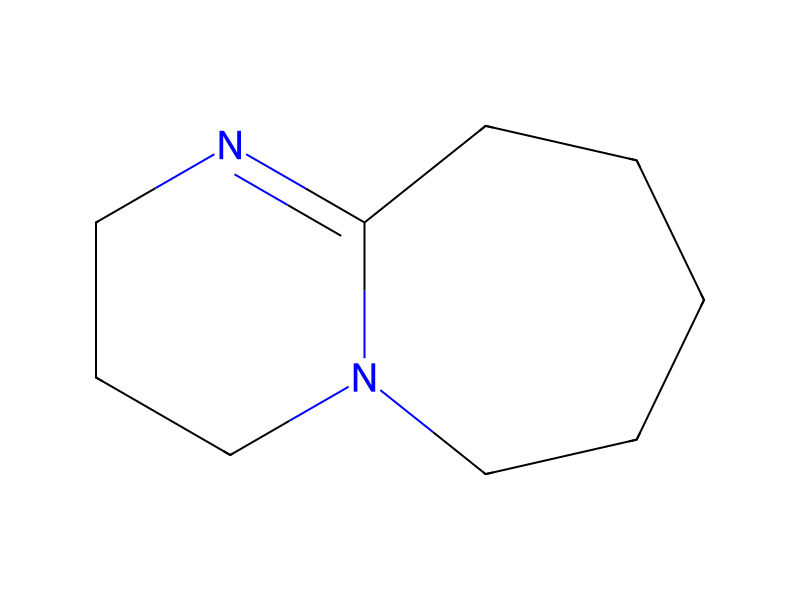
1,8-Diazabicyclo(5.4.0)undec-7-ene → 1-Hydroxy-6-methoxy-2-naphthalenecarboxylic acid, methyl ester
HRID 35664
Reaktionsgleichung

Br[C:2]1([C:15]([O:17][CH3:18])=[O:16])[CH2:11][CH2:10][C:9]2[C:4](=[CH:5][CH:6]=[C:7]([O:12][CH3:13])[CH:8]=2)[C:3]1=[O:14].N12CCCN=C1CCCCC2>O1CCCC1>[OH:14][C:3]1[C:4]2[C:9](=[CH:8][C:7]([O:12][CH3:13])=[CH:6][CH:5]=2)[CH:10]=[CH:11][C:2]=1[C:15]([O:17][CH3:18])=[O:16]Komponenten
4
Edukt 2

Produkt 1

Reagenzien, Katalysatoren, Lösungsmittel 1

Versuchsvorschrift
A solution of 10.2 g (0.033 mole) of 1,2,3,4-tetrahydro-2-bromo-6-methoxy-1-oxo-2-naphthalenecarboxylic acid, methyl ester in 100 ml of tetrahydrofuran under a nitrogen atmosphere was treated over 15 minutes with a solution of 10.0 ml (10.2 g; 0.067 mole) of 1,8-diazabicyclo[5.4.0]undec-7-ene in 20 ml of tetrahydrofuran. The mixture was stirred at room temperature for 16 hours, then added to 450 g of ice/water. Acidification with 6.0N hydrochloric acid precipitated the crude naphthalene ester product. The solid was filtered, washed with water, and recrystallized from aqueous methanol to yield 5.1 g (67% yield) of the final product, mp 109°-111°. This material was identical with that prepared by the procedure described in Example 11.