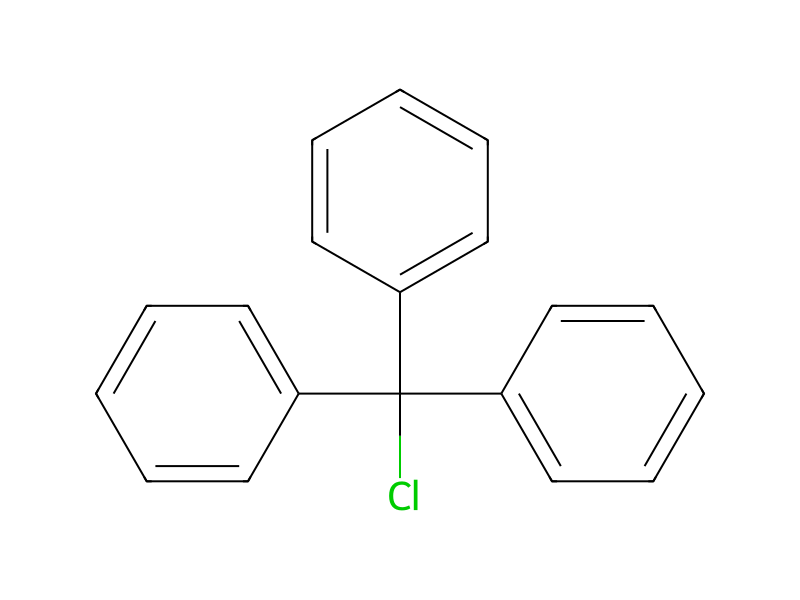
Trityl chloride → Methyl 2,2-dimethyl-3-trityloxy-propionate
HRID 375740
Reaktionsgleichung

[OH:1][CH2:2][C:3]([CH3:9])([CH3:8])[C:4]([O:6][CH3:7])=[O:5].[C:10](Cl)([C:23]1[CH:28]=[CH:27][CH:26]=[CH:25][CH:24]=1)([C:17]1[CH:22]=[CH:21][CH:20]=[CH:19][CH:18]=1)[C:11]1[CH:16]=[CH:15][CH:14]=[CH:13][CH:12]=1>N1C=CC=CC=1>[CH3:8][C:3]([CH3:9])([CH2:2][O:1][C:10]([C:11]1[CH:16]=[CH:15][CH:14]=[CH:13][CH:12]=1)([C:23]1[CH:24]=[CH:25][CH:26]=[CH:27][CH:28]=1)[C:17]1[CH:18]=[CH:19][CH:20]=[CH:21][CH:22]=1)[C:4]([O:6][CH3:7])=[O:5]Komponenten
4
Edukt 2

Produkt 1

Reagenzien, Katalysatoren, Lösungsmittel 1

Versuchsvorschrift
To a solution of 25.0 g of methyl 3-hydroxy-2,2-dimethylpropanoate in 100 ml of pyridine, cooled to 0° C., were added 55.7 g of trityl chloride. The mixture was stirred at room temperature for 20 hours, and then the solvent was evaporated in vacuo. The residue was taken up in 200 ml of ethyl acetate, and the solution was washed successively with water, 1N hydrochloric acid, water, saturated sodium bicarbonate solution and brine. The organic layer was dried over sodium sulfate, and the solvent was evaporated in vacuo. The residual oil was taken up in 50 ml of methylene chloride, and to the solution were added slowly, at 0° C., 300 ml of hexane. Trityl alcohol crystallized and was filtered off. The filtrate was evaporated in vacuo to yield 53.5 g of raw methyl 2,2-dimethyl-3-trityloxy-propionate.