Reaktionsgleichung
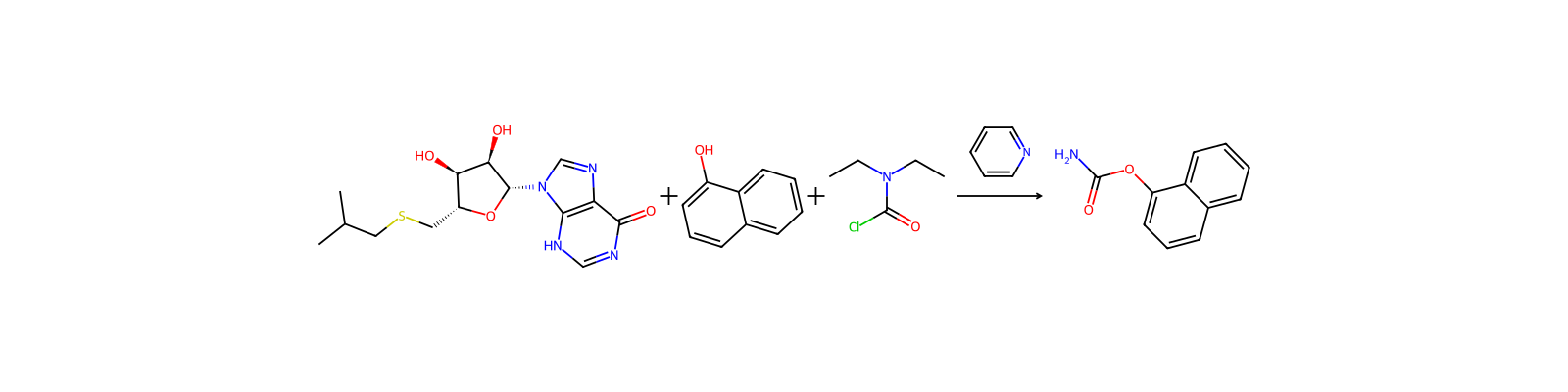
CC(CSC[C@H]1[O:11][C@@H:10]([N:12]2C3NC=NC(=O)C=3N=C2)[C@H](O)[C@@H]1O)C.[C:24]1([OH:34])[C:33]2[C:28](=[CH:29][CH:30]=[CH:31][CH:32]=2)[CH:27]=[CH:26][CH:25]=1.C(N(CC)C(Cl)=O)C>N1C=CC=CC=1>[C:10](=[O:11])([O:34][C:24]1[C:33]2[C:28](=[CH:29][CH:30]=[CH:31][CH:32]=2)[CH:27]=[CH:26][CH:25]=1)[NH2:12]Komponenten
5
Edukt 3


Produkt 1

Reagenzien, Katalysatoren, Lösungsmittel 1

Versuchsvorschrift
Sibi et al (J. Org. Chem., 48 (11), 1935-1937, 1983) disclose reaction of 1-naphthol with diethyl carbamyl chloride in pyridine to produce a 1-naphthyl carbamate. Treatment of 1-naphthyl carbamate under the standard conditions for methylation of tertiary amides (1.1 equiv. sec-BuLi/TMEDA/THF/-78° C./1 hour) followed by quenching with methyl iodide, warming to room temperature (8 to 12 hours) and NH4Cl work-up, afforded 2-methyl-1-naphthyl carbamate in a yield of 90%. Carbamate removal was effected in a yield of 90% by reduction (LAH/THF/reflux;H+) or hydrolysis (NaOH/aqueous CH3OH or HO(CH2)2OH/reflux) to yield 2-methyl-1-naphthol.
Quellen und Nachweise
- ORD-Eintrag
- ord-8ea9c06632a74f1eab8c659878d75e91
- Quelldatensatz
- uspto-grants-1995_05
- Patentnummer
- US05420362
Verknüpfte Notizen
Wird geladen…