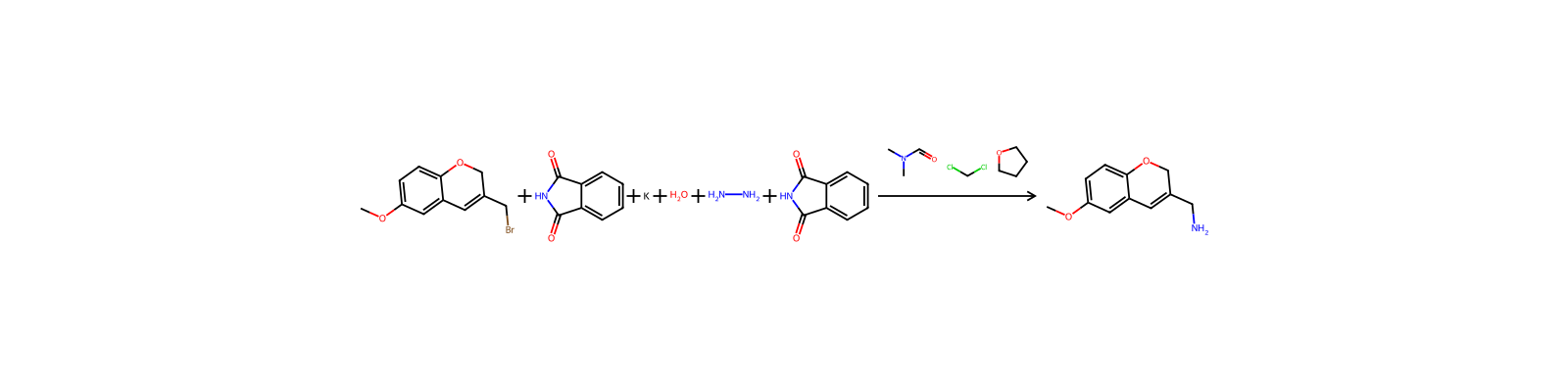
1.17 g (4.59 mmol) of the brominated compound obtained in Step A are dissolved in 10 ml of anhydrous N,N-dimethylformamide; 1.275 g (6.9 mmol) of potassium phthalimide are then added to the medium. After 10 hours of stirring under argon, the solvent is evaporated in vacuo. The residue obtained is taken up in dichloromethane; the organic phase is then washed with water. After drying over magnesium sulphate, the solvent is evaporated in vacuo. Chromatography on a silica column (eluant: AcOEt/PE: 15/85) allows access to the corresponding phthalimide in the form of a white solid. Melting point: 141 ° C. 0.72 g (14.35 mmol) of hydrazine monohydrate is added to a solution of 1.15 g (3.58 mmol) of that phthalimide in 20 ml of THF; the mixture is then heated at reflux for 4 hours. After cooling the mixture and filtering off the solid, the filtrate is concentrated in vacuo to result in the pure title amine in the form of a yellow solid.