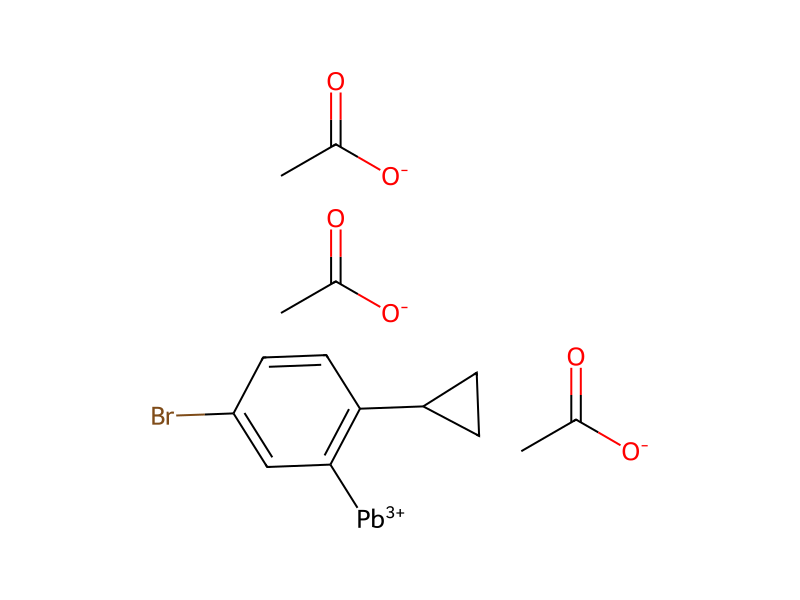
To a solution of cyclopentane-1,3-dione (0.57 g, 0.0058 mol) and 4-dimethylaminopyridine (3.64 g, 0.030 mol) in chloroform (33 ml) is added toluene (9 ml) then 5-bromo-2-cyclopropylphenyl lead triacetate (3.77 g, 0.0065 mol). This solution is heated at 80° C. for 20 hours then cooled to room temperature and diluted with dichloromethane and 2M aqueous hydrochloric acid. The resulting biphasic suspension is filtered through diatomaceous earth and the two phases are separated. The organic layer is further washed with 2M aqueous hydrochloric acid and the aqueous phase is extracted again with dichloromethane. All organic fractions are combined, washed with brine, dried over magnesium sulfate then concentrated in vacuo. The crude product is finally purified by flash column chromatography on silica gel (isohexane/ethyl acetate eluant) to afford 2-(5-bromo-2-cyclopropylphenyl)cyclopentane-1,3-dione as a pale yellow solid.