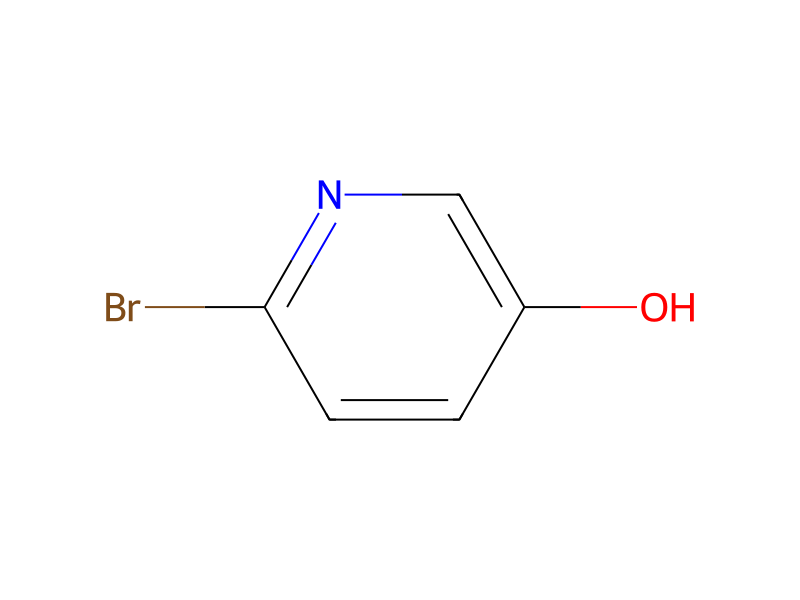
[Br:1][C:2]1[N:7]=[CH:6][C:5]([OH:8])=[CH:4][CH:3]=1.CS(O[CH2:14][CH:15]1[CH2:20][CH2:19][N:18]([C:21]2[O:25][N:24]=[C:23]([CH:26]([CH3:28])[CH3:27])[N:22]=2)[CH2:17][CH2:16]1)(=O)=O.C(=O)([O-])[O-].[K+].[K+].CN(C=O)C>O>[Br:1][C:2]1[CH:3]=[CH:4][C:5]([O:8][CH2:14][CH:15]2[CH2:20][CH2:19][N:18]([C:21]3[O:25][N:24]=[C:23]([CH:26]([CH3:28])[CH3:27])[N:22]=3)[CH2:17][CH2:16]2)=[CH:6][N:7]=1A mixture of 6-bromo-3-pyridinol (1 g, 5.75 mmol), {1-[3-(1-methylethyl)-1,2,4-oxadiazol-5-yl]-4-piperidinyl}methyl methanesulfonate (prepared as in Example 100, Steps 1-4, 1.74 g, 5.75 mmol), potassium carbonate (1.59 g, 11.49 mmol), and DMF (15 mL) stirred at 80° C. overnight. The mixture was cooled to room temperature, charged with water (100 mL), and was extracted with EtOAc. The organics were dried over MgSO4, filtered, and concentrated. The crude product was purified by chromatography on a silica gel column using 0 to 50% EtOAc/hexane to give 1.76 g (80%) of 2-bromo-5-[({1-[3-(1-methylethyl)-1,2,4-oxadiazol-5-yl]-4-piperidinyl}methyl)oxy]pyridine as a yellow solid. 1H NMR (400 MHz, CDCl3): δ 8.03 (d, 1H, J=3.1 Hz), 7.36 (d, 1H, J=8.7 Hz), 7.07 (dd, 1H, Ja=8.7 Hz, Jb=3.1 Hz), 4.21 (dd, 2H, Ja=11.0 Hz, Jb=2.1 Hz), 3.84 (d, 2H, J=6.3 Hz), 3.09 (m, 2H), 2.94-2.83 (m, 1H), 2.12-1.98 (m, 1H), 1.92 (d, 2H, J=12.2 Hz), 1.36-1.53 (m, 2H), 1.28 (d, 6H, J=7.0 Hz); LRMS (ESI), m/z 381/383 (M+H).