Hydrochloric Acid → HCID 18352665, Verbindung
Reaktionsgleichung
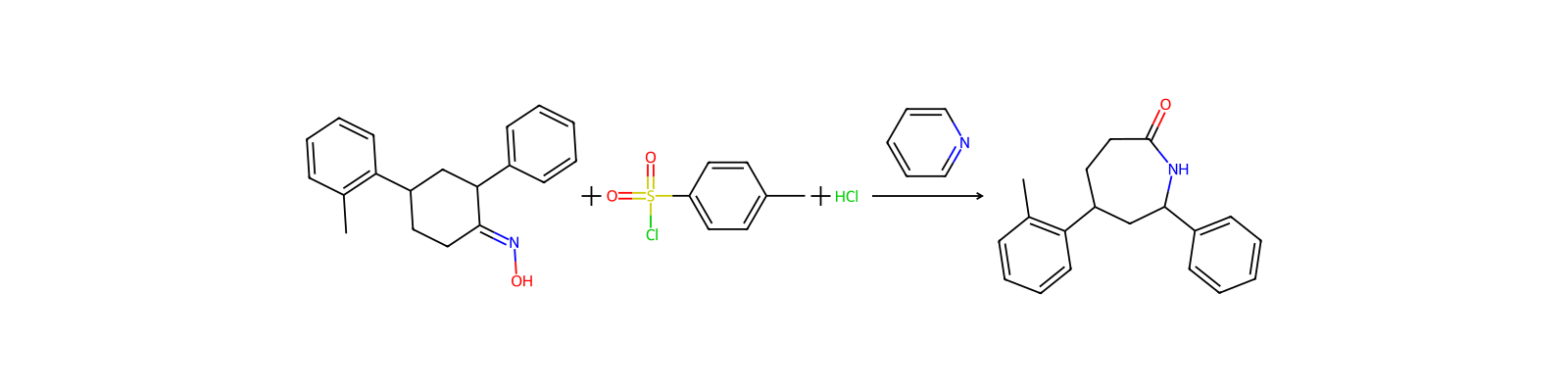
[C:1]1([CH:7]2[CH2:12][CH:11]([C:13]3[CH:18]=[CH:17][CH:16]=[CH:15][C:14]=3[CH3:19])[CH2:10][CH2:9][C:8]2=[N:20]O)[CH:6]=[CH:5][CH:4]=[CH:3][CH:2]=1.C1(C)C=CC(S(Cl)(=O)=[O:29])=CC=1.Cl>N1C=CC=CC=1>[CH3:19][C:14]1[CH:15]=[CH:16][CH:17]=[CH:18][C:13]=1[CH:11]1[CH2:12][CH:7]([C:1]2[CH:6]=[CH:5][CH:4]=[CH:3][CH:2]=2)[NH:20][C:8](=[O:29])[CH2:9][CH2:10]1Komponenten
5
Edukt 3



Produkt 1

Reagenzien, Katalysatoren, Lösungsmittel 1

Reaktionsbedingungen
- Temperatur
- 0 °C
Versuchsvorschrift
To a 250 mL round-bottomed flask equipped with nitrogen inlet were added 8.20 grams (29.4 mol) 2-phenyl-4-(2-methylphenyl)cyclohexanone oxime and 80 mL pyridine. Once the solid had dissolved, the solution was cooled to 0° C., and 27.9 grams (147 mmol) p-toluenesulfonyl chloride was added. The reaction was allowed to stir for 16 hours while the ice bath melted and the reaction warmed to room temperature. It was then poured into 300 mL 3N HCl, extracted into ethyl acetate, and the organic layer washed with additional hydrochloric acid and brine, dried over sodium sulfate, and evaporated. The residue was chromatographed on silica gel using methanol/methylene chloride as eluent to afford 5.27 grams (64%) of an amorphous solid.
Aufarbeitung
- customTo a 250 mL round-bottomed flask equipped with nitrogen inlet
- dissolutionOnce the solid had dissolved
- temperaturethe reaction warmed to room temperature
- extractionextracted into ethyl acetate
- washthe organic layer washed with additional hydrochloric acid and brine
- dry with materialdried over sodium sulfate
- customevaporated
- customThe residue was chromatographed on silica gel
Quellen und Nachweise
- ORD-Eintrag
- ord-17e594a656c641e7ad5f88a58b5fc5c0
- Quelldatensatz
- uspto-grants-2001_11
- Patentnummer
- US06319915B1
Notizen zur Reaktion
Wird geladen…